



Renewing a wildcard SSL certificate should be routine: submit the request, validate the domain, and move on with your day. But when a renewal stalls, the fallout spreads fast. Every subdomain riding on that certificate sits in limbo until the new one is issued.
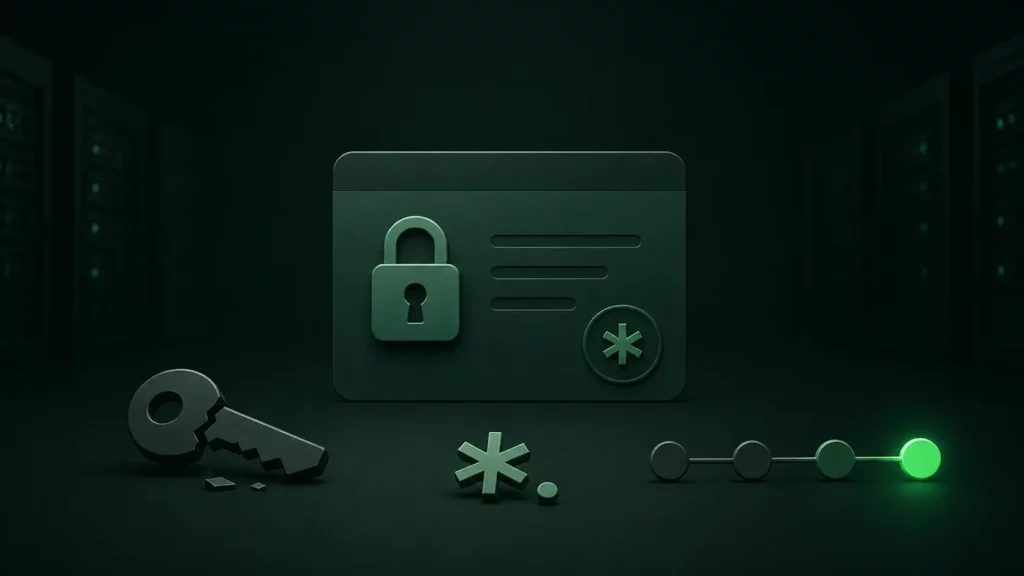
In this case, a renewal meant to cover the next year refused to advance. The validation prompt never appeared. The certificate authority rejected the CSR. And, to make things worse, DNS records were already live, yet the system wouldn’t issue anything.
What looked like a simple annual update turned into a chain of three hidden blockers, each one stopping the next step from its logical conclusion. This case study walks through what actually caused the stall, how our support team uncovered each problem, and how the renewal went from stuck to issued without canceling or recreating the order.
Client Snapshot
- Company: IT Company (name withheld at client request)
- Location: Argentina
- Industry: IT Services / Infrastructure Support
- Certificate Type: Wildcard SSL
- Coverage: Base domain + all subdomains
- Primary Challenge: Renewal blocked by CSR key rejection, wrong wildcard format, and DNS validation timing.
Key Takeaways
- A wildcard renewal can hold up before validation even starts if the CSR fails automated key checks.
- The wildcard Common Name must follow the exact format: *.domain.com.
- Even one misplaced character in the CSR can stop the certificate from issuing.
- DNS validation only works after the record has fully propagated across the internet.
- Several small issues can combine and bring the entire renewal process to a halt.
- A structured review can resolve these blockers without cancelling or recreating the order.
The Certificate Renewal That Became a Diagnostic Puzzle
An IT services company based in Argentina relies on subdomain segmentation to support internal tools, external services, and production-facing systems under a single primary domain.
To simplify management across those environments, the company uses a wildcard SSL certificate. Instead of issuing individual certificates for each subdomain, the wildcard secures every endpoint under the base domain with one certificate, the same setup we examined in Wildcard SSL in Production.
At the time of renewal, the objective was straightforward: extend coverage through November 2026 and activate the renewed wildcard certificate without disrupting deployment plans.
The renewal request had already been submitted. DNS records for validation had been added. Everything appeared in place. Yet the certificate would not be issued.
The validation option inside the account dashboard did not activate, and the system flagged errors before the issuance could be completed.
At that point, the company opened a support ticket with SSL Dragon to determine why a correctly submitted wildcard renewal would stall.
What Blocked the Wildcard Renewal
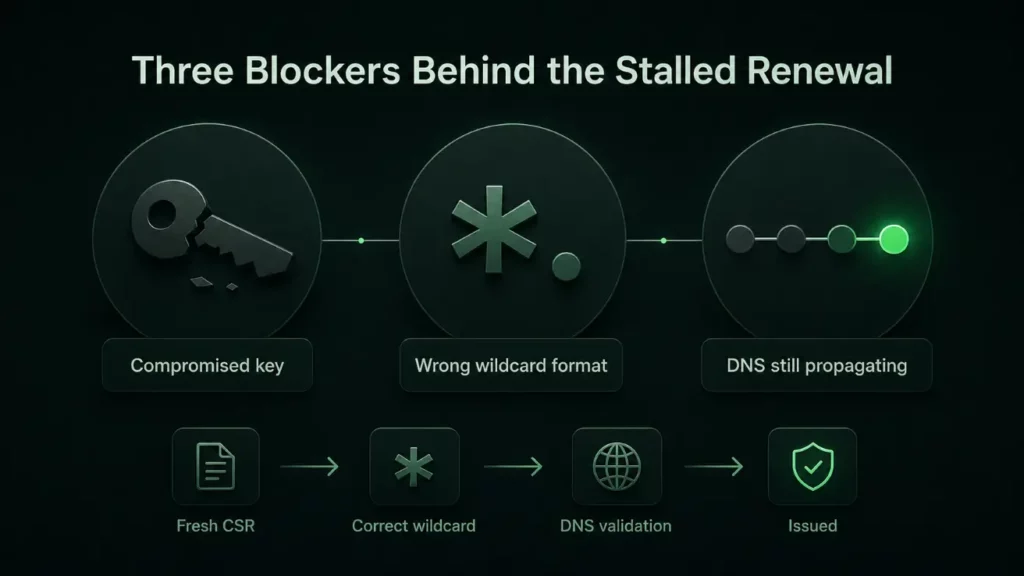
The renewal didn’t fail for a single reason. It broke down in stages. Three separate issues surfaced in sequence, and each one blocked progress until the previous problem was cleared.
1. The CSR Was Automatically Rejected
When SSL Dragon reviewed the order, the first blocker appeared at the certificate authority level.
The CA system returned the following error: “The CSR uses a key that is believed to have been compromised.”
Modern certificate authorities run automated checks against known key fingerprints. If a private key appears reused or flagged in prior issuance history, the system blocks the request immediately.
At this stage:
- DNS validation had not failed.
- The hosting configuration was not the issue.
- The renewal stopped at the cryptographic request layer.
Support instructed the client to generate a new CSR using a fresh key pair. Until that happened, the renewal could not proceed.
Once the new CSR was submitted, the order moved forward. But the process was not finished.
2. The Wildcard Common Name Was Incorrect
After decoding the newly submitted CSR, we identified a formatting problem in the Common Name field.
Wildcard certificates require an exact structure: *.domain.com.
Within this request, the dot was placed in the wrong position relative to the asterisk. That small syntax deviation prevented the CA from processing the request correctly.
Support clarified the correct wildcard format and requested another regeneration. The corrected CSR was submitted shortly after and manually replaced in the order.
At that point:
- The compromised key issue was resolved.
- The wildcard formatting error was corrected.
- The renewal could move to domain validation.
Two obstacles cleared. One remained.
3. DNS Validation Required Propagation Confirmation
The client had chosen DNS-based validation. A CNAME record had already been added to the domain, but the validation interface inside the dashboard did not initially allow revalidation.
DNS validation depends on global propagation. Even when a record is correctly configured, certificate authorities must detect it across multiple DNS resolvers before validation completes.
Our support provided:
- The exact CNAME record required
- A public DNS lookup tool for verification
- Instructions to trigger revalidation once propagation was visible
Once the record became publicly resolvable, the client triggered revalidation, and the CA completed domain verification. The certificate then moved to issuance.
Timeline Overview: Same-Day Progression
We identified and resolved the renewal issues within a single support cycle on November 3, 2025.
- The first urgent message was received shortly after 04:00.
- The compromised key rejection was identified within the first hour of review.
- A corrected CSR was submitted and manually replaced within approximately three hours of the initial request.
- DNS validation instructions were issued immediately after CSR correction.
- The renewal proceeded to validation and issuance once propagation was confirmed.
The team kept the original order intact, avoided any duplicate issuance, and didn’t touch billing. Once the blockers were cleared, the wildcard SSL moved straight through validation and into issuance on the same day.
Why This Renewal Mattered
A wildcard certificate doesn’t secure a single endpoint, but the ecosystem under a domain. When a renewal stops, entire layers of infrastructure—internal tools, client portals, staging systems, and production services—wait with it.
Our client needed coverage extended through November 2026. Until the certificate was issued, deployment plans stayed frozen.
Individually, the culprits didn’t look serious:
- Key flagged as compromised
- Minor CSR formatting issue
- DNS record is still propagating
But together, they shut the renewal down.
That’s the real takeaway: wildcard renewals rarely fail because of major system outages. They slow down because several small details create a bottleneck when they line up at the wrong moment. Under time pressure, those details become the difference between continuity and delay.
The Industry Data Behind Renewal-Driven Outages
Industry practice data shows that SSL/TLS certificates are mission-critical infrastructure: incorrectly handled renewals are among the leading causes of unexpected outages and security trust failures in many organizations.
In fact, industry analyses estimate that around 40% of enterprises face unexpected certificate outages when renewal timing, validation, or deployment processes are not fully automated or monitored
This isn’t a fringe statistic. It reflects how certificate management actually works inside modern organizations. Ownership is fragmented across DevOps, networking, security, and product teams.
Our client’s experience reflects this broader pattern. None of their issues were severe on their own, but they lined up in a way that halted the renewal. That sequence — small technical problems compounding into a service delay — is exactly what drives the industry’s outage statistics.
Build a Smoother Renewal Cycle
The renewal went from stalled to issued in a single support cycle. No cancellations, no duplicate orders, no billing changes. That’s how wildcard renewals should work.
If you’re planning ahead, SSL Dragon offers wildcard SSL certificates starting with options from Sectigo, DigiCert, and GoGetSSL, all backed by the same hands-on support that resolved this case.
If you need to generate a new CSR before your renewal, our free tool handles the formatting so you don’t run into the same blockers our client faced. Already dealing with a stalled renewal or validation issue? Open a support ticket and our team can review your order directly, the same way we did here.
وفِّر 10% على شهادات SSL عند الطلب اليوم!
إصدار سريع، وتشفير قوي، وثقة في المتصفح بنسبة 99.99%، ودعم مخصص، وضمان استرداد المال خلال 25 يومًا. رمز القسيمة: SAVE10