



SSL certificate deployment seems straightforward. You buy a certificate, submit a certificate signing request (CSR), complete domain validation, and install the issued files on the server. In practice, the CA won’t issue the certificate until the setup steps line up.

Payment confirmation, certificate configuration, CSR accuracy, and domain validation all determine whether the process flows smoothly. When any of these steps misalign, the certificate authority cannot complete issuance until the missing element is corrected.
This case study examines two real SSL rollout scenarios where certificate issuance temporarily stalled during the setup process. By reviewing how each situation unfolded and how the support team resolved it, the article highlights several common obstacles that organizations encounter when deploying SSL certificates for the first time.
Client Snapshot
- Organizations: Agroverdi Group and Percolore
- Industries: Agriculture and industrial technology solutions
- Use case: Initial SSL certificate deployment and testing environments
- Primary challenge: Certificate issuance delays caused by configuration and workflow mismatches
- SSL Dragon role: Payment verification, CSR review, configuration guidance, and domain validation support
Key Takeaways
- SSL issuance stops when payment, CSR details, or validation steps are missing.
- Trial certificates have limits and don’t support wildcard domains.
- The CSR must match the certificate type and domain coverage.
- DNS validation usually completes the domain-validated issuance process.
- Clear client-support communication resolves certificate issues faster.
Agroverdi — Securing Operational Systems
Agroverdi is an agricultural organization founded in Chile in 2004, operating vineyards and agricultural businesses across international markets. As with many companies managing web-based platforms, secure HTTPS communication is required to protect login credentials and ensure trusted browser connections.
SSL certificates hold this kind of environment together. Even internal monitoring tools and dashboards must present valid certificates to prevent browser warnings and maintain secure access for administrators and staff.
During one deployment, Agroverdi began issuing an SSL certificate through SSL Dragon to secure part of its web infrastructure. The certificate request entered the normal issuance workflow, but several operational details needed clarification before the certificate could be issued.
Percolore — Testing SSL Deployment Workflows
Percolore is a technology company that develops tintometric systems and color-mixing solutions used in retail environments, helping businesses manage paint tinting and color formulation through specialized equipment and software platforms.
As part of maintaining its digital infrastructure, the organization began testing SSL certificate deployment procedures using a trial certificate before moving to a broader implementation. Testing environments like this are commonly used to verify certificate issuance, validation, and installation workflows before deploying certificates across production systems.
During configuration, however, the certificate request did not initially match the capabilities of the trial certificate that had been selected. This mismatch created a brief interruption in the issuance workflow until the configuration was clarified and adjusted.
Case 1 — Payment Verification and Certificate Reissue
Shortly after the purchase attempt, the client reported that the system indicated an unpaid order even though the payment transaction had already been completed. In some payment gateways, authorization confirmation and internal order updates do not always synchronize immediately.
To fix the issue, the client shared a screenshot of the completed transaction along with the payment ID. Once the billing team received the information, we verified the transaction and confirmed that the payment had been successfully processed.
With the payment status corrected, the certificate order was moved forward to the configuration stage.
Adjusting the Certificate Request
During configuration, the client initially requested cancellation of the certificate order to modify the domain associated with the certificate request.
However, canceling the certificate was not necessary. The SSL Dragon support team clarified that the certificate could be reissued using a new CSR containing the corrected domain information.
This allowed the order to continue through the issuance workflow without restarting the purchase process.
The client then generated a new CSR and submitted it through the support ticket. Once we received the updated CSR, the certificate order proceeded to the domain validation stage.
Domain Validation and Issuance
Domain validation was completed through the DNS verification method. The client provided the required DNS validation record, so the certificate authority could confirm control of the domain.
After the DNS record was detected through global DNS propagation checks, the certificate authority approved the validation request and issued the certificate.
The certificate files were then delivered to the client along with installation guidance to complete the deployment.
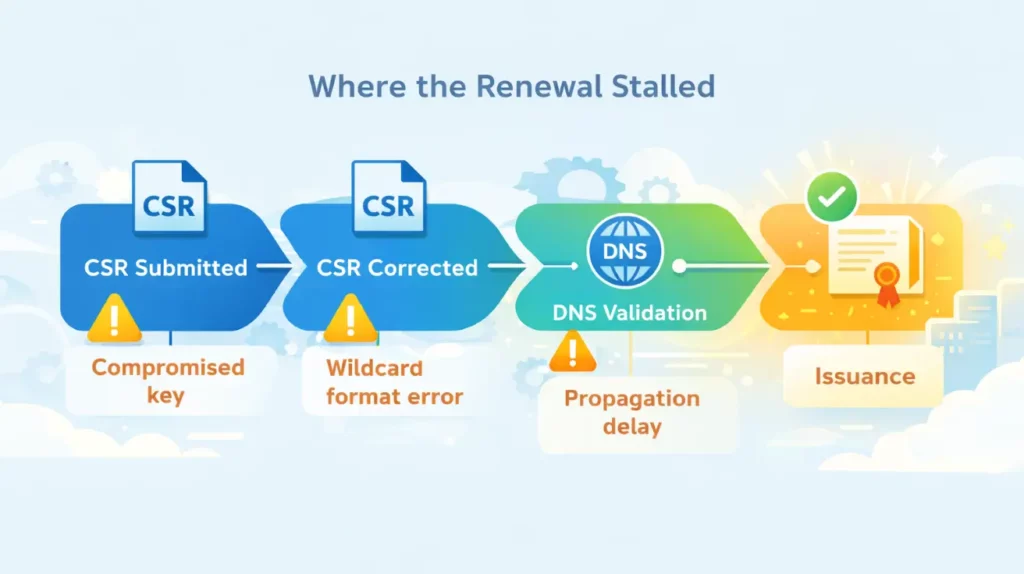
Resolution Timeline
The client reported at 08:57 that the order appeared unpaid despite a completed transaction. Support replied 19 minutes later and requested payment confirmation. The client provided the transaction details at 09:27, and the billing team verified the payment and updated the order status at 11:06, allowing the certificate setup to proceed.
The client then submitted an updated CSR and completed DNS validation. The certificate authority issued the certificate at 12:32. From the initial support request to issuance, the full cycle took 3 hours and 35 minutes.
Case 2 — Trial Certificate Limitations During Testing
Trial certificates are commonly used for this purpose because they allow teams to test installation and validation procedures without committing to a long-term certificate purchase.
During configuration, however, the certificate request created confusion regarding the intended domain coverage.
After reviewing the CSR submitted for the order, the support team determined that the request was structured differently from the deployment scenario the client intended to test.
Understanding the Product Limitation
The trial certificate used in this scenario supports single-domain coverage. Trial certificates cannot be converted into wildcard certificates and do not include support for subdomain coverage.
Because the testing goal expected wildcard functionality, the configuration did not align with the capabilities of the certificate product.
Once we clarified this limitation, the client adjusted the request so the testing process could continue using a supported configuration.
Completing Domain Validation
The support team provided the DNS CNAME validation record required for domain verification.
The client added the record to the domain’s DNS configuration and waited for it to propagate across global DNS servers. Once the record was visible through public DNS checks, the validation process was triggered through the SSL Dragon dashboard.
After the certificate authority confirmed the DNS validation record, the certificate was issued successfully and made available for installation.
The testing environment could then continue with the installation and verification of the SSL certificate.
Resolution Timeline
Percolore reported a configuration issue at 09:07 during certificate setup. Support replied 8 minutes later and requested the CSR for review. After examining the request, the team determined that the selected 90-day trial certificate did not support wildcard domains, which caused the mismatch.
Support explained the limitation and the client corrected the configuration path within roughly two hours. The following day, DNS validation instructions were provided and the certificate request continued through the standard domain-validation process.
Lessons from the Incidents
Although neither situation involved a production outage, both tickets highlight several practical aspects of SSL certificate issuance:
1. Certificate Issuance Is a Multi-Step Process
SSL certificate issuance depends on several sequential steps:
- Payment confirmation
- CSR submission
- Domain validation
If a step is missing, the CA pauses issuance until the client completes it.
Operational takeaway
- Confirm payment status before beginning configuration
- Verify CSR details before submission
- Choose the correct validation method early in the process
2. Certificate Capabilities Must Match the Deployment Goal
Trial certificates are useful for verifying installation procedures, but they support only basic configurations. More advanced use cases, such as wildcard coverage or multi-domain rollouts, require dedicated certificate products designed for those purposes.
Operational takeaway
- Select certificate types based on deployment requirements
- Use wildcard certificates when subdomain coverage is needed
- Treat trial certificates primarily as installation tests
3. Clear Communication Accelerates Resolution
Both tickets were solved quickly once the support team and the client clarified the intended certificate configuration.
Providing transaction details, CSR files, and validation records early in the process helped the SSL Dragon support team to pinpoint the problem and move the issuance workflow forward.
Operational takeaway
- Share CSR files early when troubleshooting configuration issues
- Confirm certificate requirements before submitting configuration forms
- Verify DNS propagation before triggering domain revalidation
Strengthen Web Security with SSL Certificates
SSL Dragon offers a full range of SSL certificates for every setup, including single-domain, wildcard, and multi-domain options. If you’re planning a new deployment or expanding certificate coverage, explore the available SSL solutions and choose the configuration that fits your infrastructure.
আজ অর্ডার করার সময় SSL শংসাপত্রে 10% সংরক্ষণ করুন!
দ্রুত ইস্যু, শক্তিশালী এনক্রিপশন, 99.99% ব্রাউজার বিশ্বাস, নিবেদিত সমর্থন, এবং 25 দিনের অর্থ ফেরত গ্যারান্টি। কুপন কোড: SAVE10