



Certificate deployments rarely fail at the moment of installation. Most issues surface later when trust relationships extend beyond the server itself and into the wider ecosystem that interprets certificate chains.

Root authority transitions, cross-signing shifts, and trust store dependencies can introduce edge cases that do not appear during validation or issuance. When they do surface, the impact often reaches production environments without warning.
This case study examines one such incident, where a routine certificate renewal triggered unexpected trust alerts across live systems. What followed required rapid diagnosis, rollback containment, and a safety plan executed under an active expiration deadline.
Client Snapshot
- Company: Clothing Retailer (name withheld at client request)
- Country: Turkey
- Industry: Retail Clothing / eCommerce
- Deployment Type: Multi-Domain Wildcard SSL
Key Takeaways
- A certificate can be valid and still trigger trust warnings.
- Root authority changes don’t get recognized everywhere at the same time.
- One wildcard certificate affects many domains at once.
- Rolling back restores stability, but only temporarily.
- Running two solutions at the same time protects production.
A Routine Renewal Brings an Unusual Response
One of Turkey’s largest retail fashion brands, operates a high-traffic eCommerce presence across multiple regional domains. Its digital storefront supports customers in several markets, with wildcard coverage used to secure subdomains tied to localized services, campaigns, and backend systems.
At the time of renewal, the certificate in question secured four domains, including both primary domains and wildcard coverage. This structure meant that a single trust issue would not affect one site, but an entire slice of the company’s public-facing services.
The first sign of trouble came from monitoring alerts rather than customer reports. Internal checks flagged a certificate chain warning tied to the newly issued wildcard deployment. Soon after, browser-level alerts began surfacing in certain scenarios, referencing a “self-signed certificate in chain” condition.
At that point, the issue moved from routine monitoring noise to an operational concern.
The company opened a support ticket with SSL Dragon to investigate the discrepancy. Early diagnostics confirmed that the certificate itself had been issued correctly. The anomaly appeared deeper in the trust chain rather than in the deployment layer.
Tracing the Trust Break
When the ticket reached SSL Dragon’s support team, our priority was containment without assumption. Alerts alone do not confirm failure. They signal inconsistency. The first task was to determine whether the issue originated in deployment, issuance, or trust interpretation. Once the fault line was clear, we acted.
Verifying the Deployment Layer
The support team started by checking the basics.
They verified the certificate first. Validation had gone through cleanly. The SAN list matched the domains submitted during issuance. Installation on the server followed the expected binding process.
To rule out any deployment issues, the team ran three quick checks:
- Confirmed the certificate was valid and not nearing expiration
- Matched the SAN entries to the requested domain coverage
- Reviewed the full certificate chain served from production
Everything lined up. No hostname mismatches showed up. No missing intermediates. No binding errors on the server.
The certificate itself wasn’t the problem. That clarity helped us narrow the issue fast without chasing the wrong layer.
Shifting Focus to the Trust Chain
With configuration ruled out, attention moved upstream. If the certificate was valid and installed correctly, the anomaly had to originate in the issuing hierarchy.
The renewed wildcard had been chained under Sectigo’s updated R46 root path. The transition itself was legitimate and compliant. However, external validation scans and monitoring platforms flagged the R46 root chain despite its valid trust status.
The result: warnings caused by how some systems recognized the chain, not by any fault in the certificate itself.
We traced the warning back to a few clear factors:
- The certificate had been issued under a newer root authority.
- Some monitoring tools didn’t yet recognize that root.
- Different systems evaluated the chain in different ways.
- This triggered “self-signed in chain” alerts even though the certificate was valid.
Evaluating Risk Under a Tight Deadline
At that stage, the safest move was to roll back. The retailer reinstalled the previous certificate, the one issued under the older RSA DV Secure Server > USERTrust RSA chain. It stopped browser warnings, and production looked stable again.
But that fix came with a clock attached. The old certificate had twelve days left before it expired, and that changed everything.
Keeping the fallback certificate in place would buy time, but not much of it, while leaving the new certificate live would bring the trust warnings back. Neither option solved the root issue.
Now the support team faced two tasks at once:
- Keep production stable
- Put a permanent fix in place before the expiration deadline
This wasn’t a single-site setup. The wildcard certificate covered multiple domains and subdomains. If errors reappeared, it wouldn’t affect just one page, but also storefront systems and regional services.
What started as a chain warning now carried real operational weight. The clock was running.
Working Two Fixes at the Same Time
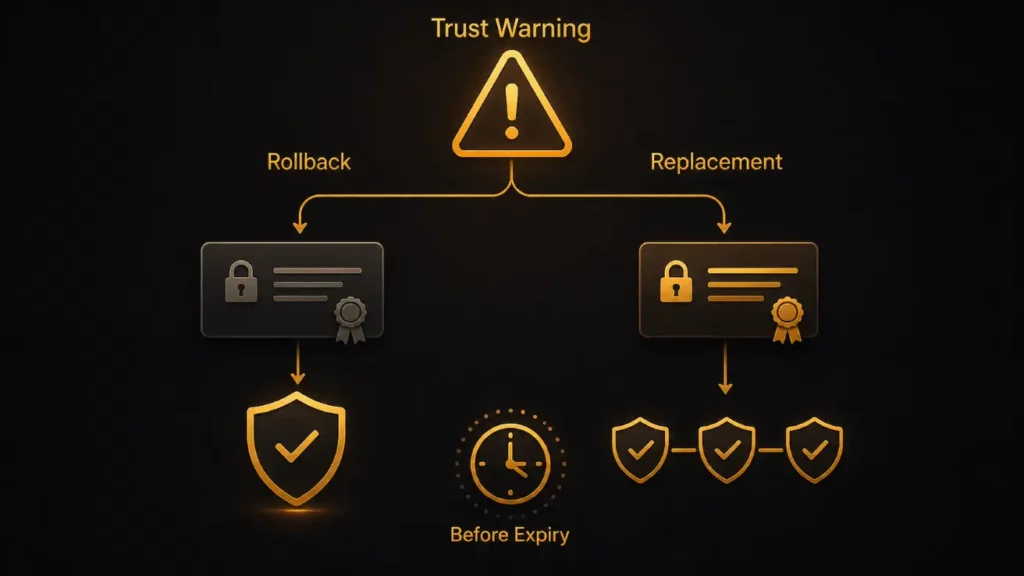
The rollback restored stability, but it didn’t remove the underlying risk. With twelve days left before the fallback certificate expired, the margin for delay was thin. Waiting for trust ecosystems to adjust on their own wasn’t a workable plan. A permanent resolution had to move forward while production remained shielded.
The support team approached the situation on two parallel tracks, each designed to remove dependency on a single outcome.
Moving the Case to the CA
We submitted an immediate request to Sectigo, asking for the certificate to be reissued under the previous trust path, specifically the RSA Domain Validation Secure Server > USERTrust RSA chain. That hierarchy had already proven stable across the retailer’s infrastructure and monitoring landscape, so returning to it offered the most direct path to restoring compatibility.
The case moved fast from investigation to time pressure. The fallback certificate kept production stable, but it came with a limitation. Only twelve days remained before it expired.
That meant the team couldn’t just request a reissue and wait. They had to resolve the trust issue and replace the certificate before that window closed, without disrupting live services.
Preparing a Backup Certificate
We provisioned a GoGetSSL Multi-Domain Wildcard certificate as a contingency replacement, built to mirror the original deployment exactly. The SAN structure replicated all secured entries.
This ensured that, if deployed, the replacement certificate would preserve full domain coverage without requiring further adjustments.
We applied the remaining credit from the original Sectigo purchase toward the new certificate. That way, the retailer didn’t have to go through another payment cycle before validation could begin.
Domain validation went without issue, and the certificate was issued shortly afterward. Soon after, the retailer had a fully trusted replacement ready to deploy if needed.
By pushing both tracks, we removed the risk of waiting on a single outcome. Production no longer depended on one response or timeline.
How Fast the Issue Was Resolved
The issue was first reported late on December 24, 2025 and the team contacted Sectigo the next day with an urgent request for reissuance. Sectigo indicated a 12 to 24 hour response window, so the team moved immediately instead of waiting.
By the evening of December 25, a fully validated replacement certificate was already provisioned as part of the backup plan. Early on December 26, the client confirmed that the environment was operating normally again.
With twelve days still remaining before the fallback certificate expired, the team secured a stable replacement well within the available window and avoided a last-minute scramble.
Measuring the Real Exposure
On the surface, the issue was a single certificate warning. In reality, the exposure ran much wider.
The wildcard certificate secured:
- Four primary SANs
- Multiple subdomains under each wildcard scope
- Customer-facing storefront endpoints
- Regional services connected to the same domain structure
- So one trust alert pointed to an entire cluster of live services.
A multi-domain wildcard certificate doesn’t protect one endpoint. When warnings appear, they can surface across multiple services. Customers see browser alerts. Internal monitoring flags the same trust issue repeatedly. Both create pressure, even if the site itself remains online.
At the same time, the fallback certificate carried a fixed expiration date. With twelve days remaining, the window for a clean resolution was tight.
That combination, broad domain coverage and limited time, pushed the issue beyond technical noise. It became an operational priority.
What This Case Reinforces for Multi-Domain Deployments
Several practical lessons emerged from the case.
- Renewal doesn’t end the job. Teams can install a certificate without errors and still face trust problems. After deployment, they need to scan the cert for potential issues. When alerts show up, they need to investigate them, not assume they’ll disappear.
- Root changes can trigger false alarms. A CA certificate can be fully valid and still raise warnings if monitoring tools don’t yet recognize the newer root authority behind it.
- Timing shapes response options. Teams that let fallback certificates run close to expiration limit their own maneuvering room. When only days remain, they lose flexibility to test fixes, request reissues, or escalate safely.
- Don’t rely on one path. The support team escalated the case to the CA while preparing a backup certificate in parallel. That dual track removed dependency on a single response timeline and kept production protected.
- Trust warnings carry operational weight. Browser alerts and monitoring errors create pressure fast. Internal teams must investigate them, and external users start questioning site safety the moment warnings appear.
Stay Ahead of SSL Trust Issues
Wildcard certificates carry a lot of weight. We help you deploy them cleanly, renew them on time, and avoid last-minute fire drills. See our multi-domain wildcard certificates and lock in stable coverage across every domain you manage.
Risparmia il 10% sui certificati SSL ordinando oggi stesso da SSL Dragon!
Emissione rapida, crittografia avanzata, affidabilità del browser al 99,99%, assistenza dedicata e garanzia di rimborso entro 25 giorni. Codice coupon: SAVE10