



Multi-domain SSL certificates tend to expose gaps that routine maintenance never caught. In this case, a straightforward renewal for an enterprise email setup turned out to be anything but. The CSR had drifted from the actual environment, the SAN list needed reworking, and validation required coordination across domains and contacts that had changed since the original certificate was issued.

The trickier problem was never the certificate itself, but fitting the reissued certificate into an evolving infrastructure. This case study follows that process from reissue through installation, and highlights what teams managing SSL at this scale consistently struggle with.
Client Snapshot
- Client: Global reinsurance firm (name withheld at client request)
- Certificate: Sectigo PositiveSSL Multi-Domain (UCC/SAN)
- Environment: Hybrid Exchange, multi-domain mail and autodiscover hostnames
- Core issue: Renewed certificate didn’t match the evolved infrastructure, triggering CSR rebuild, SAN expansion, cross-timezone validation, and a key mismatch at install
Key Takeaways
- Renewals fail when the environment has changed.
- SAN changes add validation complexity.
- CSR drift breaks clean reissues.
- Issuance does not guarantee installation.
- Multi-domain SSL needs precise planning.
A Reinsurance Firm, a Hybrid Exchange Setup, and a Certificate That Kept Shifting
A reinsurance firm supporting global insurers faced a complex hurdle with their enterprise email security. What began as a routine renewal of a multi-domain certificate quickly evolved into a high-stakes technical puzzle.
In a massive messaging environment where email services and auto-discovery hostnames span multiple domains, digital certificates are more than just a security checkbox. They must perfectly align with how the underlying infrastructure resolves names and handles data across different regions.
When the company’s initial certificate failed to work in their specific setup, the standard renewal process hit a wall. The team encountered a domino effect of challenges: rejected signing requests, the need for new configurations to support a hybrid Exchange setup, and a fluctuating list of domains that required protection.
Each change triggered new validation steps across various domain contacts and international offices. Through precise adjustments to the infrastructure requirements and steady communication, the new certificate was finally validated, reissued, and deployed, restoring seamless security to their global communications.
When the Renewal Stopped Being Routine
The first sign that this wasn’t a standard multi-domain renewal appeared the moment the client tried to deploy the newly issued certificate. On paper, the task was simple: renew the existing coverage for their email infrastructure and move on. In practice, the certificate was a non-starter.
The client realized the standard CSR used during the initial automated process didn’t account for the nuances of their Exchange server. Their operations, a hybrid email system required a request built specifically for its unique configuration.
This immediately shifted the nature of the project. It was no longer a routine workflow but a technical mismatch. SSL Dragon’s role pivoted from processing an order to working backward from the client’s infrastructure to identify what a functional request actually looked like.
Rebuilding Around the Real Hostnames
As the client generated a new CSR for their hybrid setup, the true scope of the project began to expand. What started as a renewal for a specific set of names grew into a broader list of mail and autodiscover records across several related domains.
When SSL Dragon reviewed the exact SAN (Subject Alternative Name) list against the system’s requirements, a gap emerged: the hostnames the client actually needed exceeded what the original order covered.
Rather than forcing a partial fit, support clarified the discrepancy. The client expanded their SAN allocation mid-process, allowing the certificate to grow alongside their actual needs.
This highlights a common reality in enterprise renewals: environments are rarely static. The SAN list had to be rebuilt in tandem with the CSR, hitting a moving target rather than simply replacing a predecessor.
A Lesson in Cross-Domain Coordination
With the right domains confirmed and the certificate reissued, the next step was validation, and that’s where things slowed down. Covering multiple domains meant there was no single approval to click through. Each domain had its own contact, its own timeline, and its own region.
Validation emails had to be routed to specific contacts across different regions. SSL Dragon managed the flow—updating details, resending messages, and tracking which names were cleared and which were pending.
The friction here was logistical; at one point, overlapping business hours across international offices slowed the pace. Support stayed anchored in the details, ensuring no domain was lost in the shuffle and keeping the validation path moving steadily toward the finish line.
Solving One Problem, Exposing Another
The next problem had nothing to do with domains. Once the certificate landed, it wouldn’t pair with the server — the key it was built against no longer matched what the setup was running. While the reissue was in progress, the infrastructure had changed. The certificate was correct, but it had been issued for a moment that had already passed.
Our support stepped in to clarify the file structures and explain the issuance logic—specifically how certificates function within a multi-year subscription. Another reissue ensured the certificate finally caught up with the current CSR.
The Final Stretch
The closing phase brought these moving parts together. The client submitted the final CSR, confirmed validation for the primary domains, and coordinated the last few approval emails. We monitored the status in real-time, attaching the updated certificate files directly so the client could finish the job without waiting for the order page to refresh.
Shortly after, the client confirmed a successful installation. Looking back, this was never a linear renewal but a series of distinct, evolving problems: from changing SAN requirements and hybrid Exchange configurations to cross-border coordination and key-matching issues.
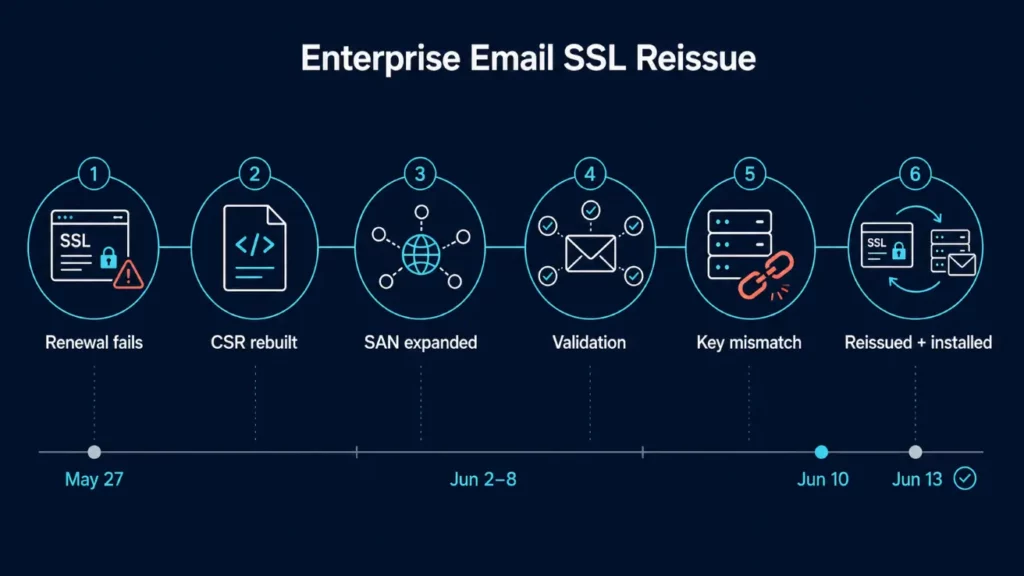
Timeline and Resolution
The case opened on May 27, when the client found that the issued certificate could not be used. What followed was a short sequence of adjustments involving domain approvals, and a revised request that had to catch up with the realities of the deployment.
Between June 2 and June 8, SSL Dragon kept the process moving by coordinating validation and monitoring what was still outstanding. After issuance, one last problem surfaced during installation when a regenerated CSR no longer matched the certificate that had been produced.
The certificate was reissued again on June 10, and the client confirmed successful installation on June 13. In the end, the renewal was completed, but only after the certificate process was brought back into step with the setup it was meant to support.
What This Case Reveals About Multi-Domain Reissues
Complex reissues don’t fail for one reason. They do it in layers. Here is what this one made clear.
The Environment Must Match the Request
The most difficult aspect of this case wasn’t the renewal itself, but the discovery that the old certificate no longer mirrored the current infrastructure.
When a target environment evolves beyond the original request, a simple renewal path must give way to a more comprehensive reissue. In enterprise security, a certificate is only effective if it perfectly aligns with the system it is meant to protect.
SAN Expansion Exposes Hidden Complexity
Multi-domain certificates often seem straightforward until their full reach is analyzed. Here, the goal shifted as the client identified the specific requirements of their Exchange setup.
Each added hostname increased the validation workload and the logistical burden. This reflects a common reality in large-scale email systems: request accuracy depends entirely on the infrastructure’s inventory behind it.
Validation as a Logistical Hurdle
The primary delays in this process weren’t caused by technical misunderstandings, but by coordination challenges. Managing different domains and multiple contacts across various time zones made validation slower and more fragile than the order itself.
In these scenarios, handling security is as much about clear communication and project management as it is about technical execution.
The Final Step: Keeping Keys in Sync
Even after successful validation and issuance, the process can still falter at the finish line. If a signing request is regenerated during the wait, the resulting certificate and the server’s private key will no longer match.
This final complication is easy to overlook, yet it proves that success isn’t just about receiving the file, but ensuring the request, the key, and the deployment context stay perfectly aligned until the very end.
Choose Multi-Domain SSL That Fits Your Environment
As this case shows, certificate management gets harder when coverage, validation, and deployment no longer move in step. In larger companies, even a routine SSL renewal can become more time-consuming once multiple domains, service hostnames, and changing requirements enter the picture.That is why choosing the right certificate upfront matters.
SSL Dragon offers multi-domain SSL certificates built for businesses that need trusted coverage across several domains under one solution. Compare leading SSL brands, find the right UCC or SAN certificate for your setup, and secure your infrastructure with the flexibility to support what comes next.
Risparmia il 10% sui certificati SSL ordinando oggi stesso da SSL Dragon!
Emissione rapida, crittografia avanzata, affidabilità del browser al 99,99%, assistenza dedicata e garanzia di rimborso entro 25 giorni. Codice coupon: SAVE10