



Wildcard SSL certificates look simple on the surface. One certificate secures a full domain and all its subdomains. For growing infrastructures, that model feels efficient, even necessary.

But production environments change the equation. Subdomains scale fast. Services move. Renewal cycles overlap. What starts as operational convenience can quickly turn into renewal risk if visibility and automation don’t keep pace.
This case study examines how one of SSL Dragon’s clients implements wildcard SSL in a live infrastructure. It focuses on the operational layer most teams underestimate — renewal coordination, trust boundaries, monitoring gaps, and the systems required to keep a single certificate from disrupting dozens of services.
Client Snapshot
- Company: SecureME
- Industry: Managed Security Services
- Founded: 1991
- Scope: Infrastructure & cybersecurity operations
- Focus: Wildcard SSL lifecycle management
Key Takeaways
- One wildcard secures entire domain clusters. Cuts deployment overhead and speeds up subdomain rollout.
- Renewals drive the real operational load. Updating every dependent system takes coordination.
- Monitoring gaps create the biggest risk. Manual tracking often leads to missed expirations.
- Ownership defines wildcard suitability. Works best when one team controls all subdomains.
- Automation keeps renewals reliable. Manual processes don’t scale.
How SecureME Uses Wildcard SSL in Production
SecureME is a managed security services provider operating since 1991, specializing in integrated cybersecurity and infrastructure protection across enterprise and client systems.
Their work spans internal platforms, externally exposed services, and segmented client environments where encryption continuity and certificate trust play a direct operational role.
As domain structures expand across those deployments, wildcard SSL becomes less of a convenience feature and more of a structural necessity.
That operational layer is overseen by Walter Russo, who manages certificate infrastructure and lifecycle operations across SecureME’s production and client environments.
Certificate Coverage Snapshot
Today, the environment he supervises includes:
- 25+ active wildcard SSL certificates
- 30+ active certificates overall (wildcard, single-domain, multi-domain)
- Coverage spanning production systems, internal platforms, and client deployments
- Renewal cycles ranging from annual to triennial validity periods
“In production, I mainly use wildcard SSL certificates. They allow me to secure an entire domain and all its subdomains with a single certificate, which simplifies configuration and reduces operational overhead,” explains Walter.
Instead of tracking individual certificates for each service layer, his team secures entire domain clusters under a single wildcard cert. That model reduces configuration repetition and removes the need to request and deploy new certificates every time a subdomain goes live.
For platforms that evolve continuously, this consolidation aligns certificate management with how services actually scale — at the domain level, not the endpoint.
Where Wildcard Efficiency Meets Renewal Reality
Once a wildcard certificate goes live, it can end up tied to more than one system. Some organizations terminate encryption in one place. Others spread it across load balancers, application servers, or internal gateways. Give it enough time, and the certificate spreads so far that tracking its locations and dependencies becomes a challenge.
That’s where SSL renewal starts demanding real coordination, and Walter has seen the pressure build firsthand:
“The hardest part is managing renewals reliably at scale. When multiple domains and environments are involved, it’s easy to miss expiration dates or fail to propagate renewed certificates everywhere they’re needed.”
Renewal isn’t just replacing a certificate before it expires. It means making sure the updated version reaches every system that uses it. Some services update instantly. Others require scheduled maintenance, manual deployment, or handoffs between teams.
“Coordinating renewals across teams, systems, and deployment pipelines is often more complex than issuing the certificates themselves,” adds Walter.
Issuing a certificate is simple because it happens in a controlled moment. Renewal is different. It occurs while everything is running, increasing pressure on timing, visibility, and clear communication.
If the new cert rolls out everywhere, nobody notices. Life goes on. But one missed update flips the whole mood: warnings pop up, requests start failing, and your internal dashboards go red.
And because wildcard certificates secure entire domain layers, the impact doesn’t stay isolated.
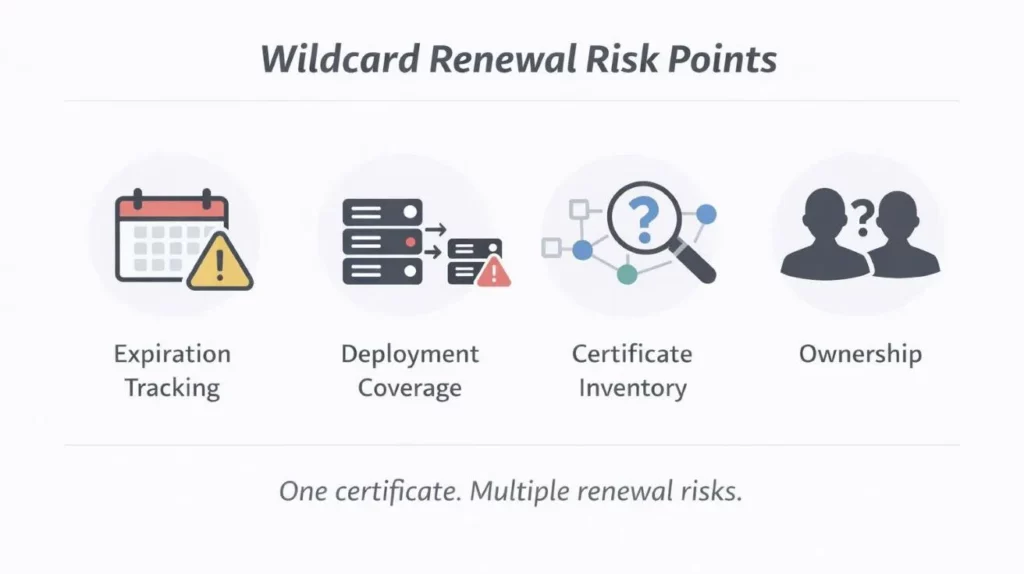
Where Renewal Pressure Builds
Walter points to several friction points that surface during renewal cycles:
- Expiration dates are tracked across separate tools or calendars.
- Renewed certificates were deployed to core systems, but missed elsewhere.
- Dependencies that aren’t fully documented.
- Teams are assuming someone else handled the update.
When things slip through the cracks, an old cert can stick around where you least expect it.
Why Wildcard Renewals Carry Broader Impact
Wildcard certificates reduce the number of certificates teams manage. But they pack more weight into each certificate you use.
- One certificate protects multiple services.
- A missed renewal affects entire domain groups.
- Fixing the issue means updating every dependent system.
- Recovery requires fast coordination across teams.
That wider service impact is what shifts wildcard SSL from a deployment convenience into an operational responsibility.
For Walter, renewing the certificate isn’t the issue. The real work comes from the systems tied to it and the effort needed to track where everything stands.
Where SSL Management Breaks Down Most Often
Operational pressure doesn’t come from certificate technology itself, but from how teams manage it.
When asked what failures surface most often, Walter doesn’t point to edge-case bugs or exotic misconfigurations. He points to habits.
“The most common mistakes are manual renewals, lack of monitoring, and poor documentation.”
Those three issues tend to reinforce each other.
Manual renewals introduce timing risk. Someone has to remember the date, log into the right system, generate the CSR, complete validation, deploy the cert, and confirm propagation. That chain works when setups are small. It breaks when systems scale. Monitoring gaps make the problem worse.
“Teams often rely on reminders instead of automation, don’t monitor certificate expiration centrally, or aren’t sure which services depend on which certificates.”
Instead of a shared visibility layer, expiration tracking happens in inboxes, calendar notes, or internal tickets. Over time, ownership blurs. Certificates outlive the teams that deployed them, and documentation drift adds the final layer of fragility.
Dependencies change. Load balancers move. But certificate inventories don’t always update with them. When renewal time arrives, teams scramble to reconstruct deployment maps that should have been visible from the start. That’s when outages hit.
When Wildcard Certificates Make Sense — And When They Don’t
Walter still prefers wildcard SSL over single-domain certificates, even if renewal is a hassle. For him, the real question isn’t convenience — it’s knowing when putting everything under one cert helps, and when it just creates more exposure. His decision process stays rooted in one thing: clear ownership and trust boundaries.
“I choose wildcard certificates when multiple subdomains belong to the same trust boundary and are managed by the same team.”
In other words, a wildcard works best when responsibility is centralized.
Walter uses them on internal platforms, staging setups, and SaaS systems with clear subdomain patterns that handle wildcards well. You file fewer certificate requests. Deployments move faster. Configs stay aligned across services that operate under the same team.
Why the Wildcard SSL Option isn’t Universal
When services sit under different operational owners, risk multiplies. A single certificate renewal suddenly depends on coordination across separate teams, release windows, and infrastructure layers.
That’s where Walter draws the line:
“I avoid them when stricter isolation or per-service ownership is required.”
In those cases, individual certificates create a cleaner separation. Each service renews independently, and issues don’t spread across domain layers.
The Shift From Renewal Reminders to Automation
As infrastructure grows, manual renewal stops being inconvenient and becomes dangerous.
Walter’s guidance here is direct:
“When managing SSL at scale—especially with a large number of wildcard certificates—the most important recommendation is to rely on automation for renewals.”
Automation removes human timing risk. Certificates renew on schedule. Validation triggers automatically. Deployment pipelines pull updated certs without manual handoffs.
He’s blunt about the alternative:
“Manual processes do not scale and increase the risk of service disruption due to expired certificates.”
The goal isn’t just automatic issuance. It’s full workflow integration.
“Teams should adopt automated workflows for certificate issuance and renewal, ideally integrated into their infrastructure or deployment pipelines.”
That means tying renewal into CI/CD, configuration management, or secret distribution systems so updates flow the same way application changes do.
Even wildcard consolidation doesn’t remove that need.
“Even when using wildcard certificates to reduce complexity, having a reliable and tested renewal mechanism is essential, since a single expired certificate can impact many services at once,” concludes Walter.
Extending Trust Beyond TLS: The Role of VMC
While most teams focus strictly on transport-layer encryption, Walter’s certificate scope stretches into brand trust as well.
When asked whether he manages certificates beyond SSL, he points to Verified Mark Certificates.
“Yes, in addition to SSL certificates, I also use VMCs (Verified Mark Certificates) as part of the BIMI standard.”
VMC ties verified brand logos to outbound email, allowing supported mail clients to display the sender’s authenticated logo directly in inbox views. That visual signal does more than branding.
“VMCs allow verified brand logos to be displayed in supported email clients, helping improve brand recognition, user trust, and protection against phishing.”
If spoofed emails can cause financial or reputation damage, that visibility makes recipients feel safer. But VMC brings its own renewal pressure:
“Managing these certificates requires particular attention to renewal timelines, as expiration can directly impact brand visibility in email communications,” warns Walter.
Unlike TLS outages, which disrupt system access, VMC expiration erodes trust signals. Logos disappear. Authenticity indicators drop and phishing detection optics weaken.
From Renewal Risk to Automation Control
Wildcard SSL is convenient when first deployed. You manage fewer certificates, bring new subdomains online faster, and keep early configuration work contained as infrastructure expands.
But as Walter’s experience shows, the wildcard doesn’t remove operational pressure. One renewal cycle ends up touching every service tied to that domain layer.
That’s where visibility and coordination become critical. Renewals need tracking. Monitoring needs to stay centralized. And automation shifts from helpful to necessary.
SSL Dragon supports teams operating wildcard deployments through automation-ready certificate management, renewal workflows, and lifecycle visibility designed to reduce blind spots before they turn into outages.
You may run a single certificate, but the systems depending on it rarely operate as a single unit. That’s the balance wildcard environments introduce:streamlined deployment at the start; ongoing operational responsibility behind the scenes.
Discover SSL Dragon’s wildcard SSL and ACME automation tools designed to help organizations simplify certificate management and keep renewal processes running smoothly at scale.
Economisește 10% la certificatele SSL în momentul plasării comenzii!
Eliberare rapidă, criptare puternică, încredere în browser de 99,99%, suport dedicat și garanție de returnare a banilor în 25 de zile. Codul cuponului: SAVE10