



The cybersecurity crowd loves to pitch certificate automation as some sleek, forward-thinking upgrade for the modern web. But let’s be real: we didn’t get here because everyone suddenly became proactive. We got here because the industry kept messing up. Automation isn’t a reward for good behavior; it’s an intervention.
For years,we’ve seen a spectacular parade of expired certificates, exposed private keys, broken validation checks, failed root transitions, and emergency revocations that left IT personnel sweating over spreadsheets.

Digital trust is funny like that. Nobody cares when it works. When it breaks, it usually involves a major company running around like its hair is on fire.
As we slide into an era of relentless 47-day certificate cycles, manual management is finally being left for dead. So it’s only fair to look back at the chaos that brought us here. Here are ten modern SSL blunders that made automation feel less optional by the year, ranked from mildly embarrassing to brutally expensive.
10. GlobalSign’s OCSP Meltdown: When Browsers Rejected Valid Certificates
In October 2016, GlobalSign proved certificates don’t need to expire to trigger an outage. During routine maintenance, the company revoked an old cross-certificate.
The real mess started when its OCSP service, the status check browsers use to see if a certificate has been revoked, began returning bad data for intermediate certificates.
Suddenly, browsers rejected valid TLS certs that relied on those intermediates. GlobalSign hadn’t revoked customer certificates directly. It just broke the bridge that allowed browsers to trust them.
The Damage
The fallout hit major sites, including Wikipedia, Dropbox, The Guardian, LogMeIn, and the Financial Times. Visitors trying to reach real HTTPS pages were slapped with certificate-revoked warnings, even though the affected sites hadn’t suddenly become unsafe.
That is the maddening part: nothing needed to be wrong with the actual website certificate for users to hit a wall.The meltdown showed why revocation systems are so dangerous when they fail. A single corrupted status response can instantly blindside a healthy deployment and trigger a massive, public blackout.
The Lesson
No magic regulation fixed this overnight. Recovery relied on GlobalSign correcting the source data and affected operators applying quick workarounds.
Certificate status checks are part of uptime. SSL Automation can’t stop a CA from broadcasting bad data, but it dictates how fast you react when a chain needs to be replaced or reissued. Otherwise, you’re staring at browser errors while an email reminder pretends to be an incident response plan.
9. Microsoft Teams Forgot Its Own Certificate Expiry Date
A global collaboration platform going down because of an expired certificate sounds like a cautionary tale for a small IT team, not a Microsoft product used across the enterprise world. But that’s what happened to Microsoft Teams in February 2020.
Users started reporting access problems on a Monday morning. Microsoft later confirmed the cause in painfully plain language: “We’ve determined that an authentication certificate has expired causing users to have issues using the service.” The fix was exactly as glamorous as the cause. Microsoft had to deploy an updated certificate and wait for service health to recover.
The Damage
The outage lasted nearly three hours for many users and hit while Microsoft was pushing Teams as a serious workplace collaboration platform. That made the embarrassment worse. When your product is supposed to keep offices connected, “the certificate expired” is not the kind of root cause anyone wants in the incident notes.
The technical mistake was basic, and that’s precisely why it stung. This wasn’t some mysterious cloud failure, but a preventable problem every certificate manager is supposed to catch before users do.
The Lesson
Certificate expiry is not a small maintenance chore when the certificate sits inside a live authentication flow. One missed date can block users, break trust, and turn a normal workday into a public status-page apology.
Automation exists because reminders and shared ownership fail at scale. A production certificate should not depend on someone remembering to renew it before coffee on Monday.
8. DigiCert’s Missing Underscore: The Tiny Typo That Put 83,000 Certificates on the Clock
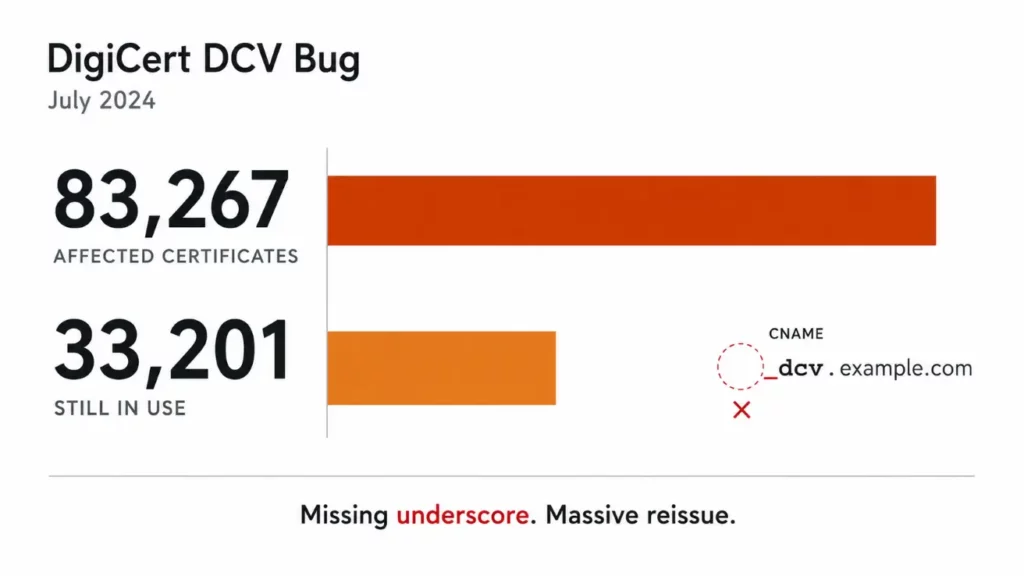
DigiCert’s July 2024 troubles started with a tiny DNS character. The CA found a bug in its Domain Control Validation process where some CNAME-based validations were missing the required underscore prefix. In normal life, that’s a typo. In public-trust cryptography, that’s a five-alarm compliance problem.
DigiCert reported 83,267 affected certificates. Censys later found 33,201 of them still in use on the public web as of July 30, which meant thousands of organizations had to reissue certificates before compliance rules turned into customer-facing outages.
The Damage
Impacted companies had to move fast. Censys noted that organizations were scrambling to replace certificates under a strict deadline, and even highlighted Alegeus, a healthcare-sector financial technology company that sought a court order to delay revocation because of the expected operational impact.
The Lesson
Domain validation is the gatekeeper that decides whether a CA may issue a certificate for a domain. The lesson was harsh: validation logic must be flawless because automation doesn’t fix a systemic mistake. It mass-produces it.
Automation on the customer side still matters, though. When thousands of certificates need replacement fast, a clean deployment pipeline is the difference between controlled rotation and watching the internet lock your doors.
7. Ericsson’s Telecom Blackout: The Hidden Certificate That Silenced Millions
Ericsson managed to turn a routine certificate expiry into a telecom disaster. In December 2018, an expired software certificate in its core network equipment triggered mobile service disruptions across 11 countries. Major carriers, including O2 in the UK and SoftBank in Japan, were affected.
The Damage
The impact was brutal. In the UK alone, more than 30 million customers were affected across O2, Tesco Mobile, Sky Mobile, and GiffGaff. Mobile data failed, voice services were disrupted, and public services felt the knock-on effect, including London’s live bus tracking.
The Lesson
Certificates don’t just sit on websites’ servers. They hide inside software, telecom nodes, appliances, APIs, and background systems nobody thinks about until they fail.
If a certificate can drop mobile networks, it needs ownership, monitoring, and replacement before expiry. Manual tracking fails when certificates are hidden inside infrastructure nobody wants to touch. Automate the lifecycle, or wait for the calendar to silence the network.
6. GoDaddy’s Validation Bug: When 8,850 Certificates Skipped the Gate
GoDaddy pulled off the kind of mistake that makes the entire Certificate Authority business look incredibly fragile. A routine code change pushed a bug into its domain validation system, and suddenly, the process meant to prove you actually control a domain stopped doing its job.
The CA later admitted the bug affected 8,850 certificates, all thanks to a code update meant to “optimize” issuance. The improvement walked into the room carrying a rake and immediately stepped on it.
The Damage
GoDaddy had to mass-revoke the affected certificates and force customers to revalidate. That pushed cleanup work onto innocent site owners who had done nothing wrong. IT teams had to swap certificates, rerun domain checks, and keep platforms from throwing browser errors while the CA swept up its own broken glass.
The reputational hit was worse. When the front gate of public trust fails, it doesn’t just create support tickets, but makes the whole SSL ecosystem look shakier than it should.
The Lesson
Validation is where public trust either holds or falls apart. If a CA approves a flawed request, the certificate looks perfectly normal to browsers, but the security model behind it has already failed.
If you manage these servers, the fallout is entirely practical. When a CA forces a sudden mass revocation, you need a way to swap certificates instantly. Manual renewal is already a chore, but manual emergency replacement is where the real struggle starts.
5. The 63-Bit Math Fail: How One Missing Bit Triggered Millions of Revocations
In 2019, Apple, Google, and GoDaddy turned a single missing bit of data into a massive compliance nightmare. The tech giants accidentally issued millions of certificates with serial numbers containing 63 bits of randomness instead of the strictly required 64. One tiny bit short.
The rule exists because serial-number randomness stops hackers from forging certificates. Ironically, the affected files worked perfectly fine in browsers, meaning nothing looked broken to everyday users. But because they technically violated public-trust rules, they were legally dead on arrival.
The Damage
This is where the compliance trap snapped shut. GoDaddy alone realized it had printed over 1.8 million non-compliant certificates and faced a logistics debacle because its broken certificates belonged to actual paying corporate clients.
¡Ahorra un 10% en Certificados SSL al hacer tu pedido en SSL Dragon hoy mismo!
Emisión rápida, encriptación fuerte, 99,99% de confianza del navegador, soporte dedicado y garantía de devolución del dinero en 25 días. Código del cupón: AHORRA10

Once a certificate fails an audit, the clock starts ticking. The pain immediately moves downstream to unsuspecting sysadmins who have to drop everything and swap out perfectly functional files before the CA pulls the plug and breaks production.
The Lesson
CAs need automated guardrails that block bad certificates before they ship, not apology notes after the fact. For everyone else, this is why you automate your own deployment. When a CA triggers a surprise mass-revocation, having an automated pipeline makes the emergency replacement completely boring, and boring is exactly what you want when someone else’s math homework lands on your servers.
4. Entrust Gets Evicted: When Browsers Fired a Certificate Authority
Entrust didn’t get hit by a freak software bug. What happened was worse. In June 2024, Chrome announced it would stop trusting new public TLS certificates from several Entrust roots after October 31, citing a pattern of public incidents that had “eroded confidence” in Entrust’s competence, reliability, and integrity.
That wasn’t a warning shot. The most popular browser told a major CA, “We don’t trust you with the keys to the building anymore.” Mozilla followed with its own distrust decision for Entrust certificates issued after November 30, 2024. Suddenly, a long-simmering debate on obscure mailing lists turned into a real browser compatibility crisis.
The Damage
Entrust customers were left staring down a hard deadline. Existing certificates lived out their natural lifespans, but newly issued certs after the cutoffs would no longer be trusted by major browsers. That meant migration planning, certificate inventory checks, new CA relationships, and uncomfortable internal meetings with “browser distrust” in the subject line.
Entrust later partnered with another provider so customers could keep receiving browser-trusted certificates. In plain English, the CA had to borrow someone else’s roots to keep issuing trusted certificates.
The Lesson
When Chrome and Mozilla moved against Entrust, they proved browser root programs are done handing out endless final warnings. They didn’t wait for one catastrophic breach but acted on repeated incidents, slow fixes, and compliance responses that failed to restore confidence.
For enterprises, that turns your CA into part of your risk surface. If your provider gets pushed out of major trust stores, renewals and new certificates can become urgent migration work overnight. You can’t manage that with crossed fingers. At this level, issuer visibility, certificate inventory, and automated migration paths aren’t luxuries. They’re survival gear.
3. Symantec’s SSL Empire Became Everyone’s Migration Project
Symantec wasn’t a fringe CA with a dusty control panel. It sat behind some of the biggest certificate brands on the web, including GeoTrust, Thawte, and RapidSSL. So when Google’s investigation into Symantec’s certificate practices grew from 127 questionable certificates to at least 30,000, this stopped being a compliance argument and became a full-scale relocation notice.
Chrome responded in stages, reducing trust in Symantec certificates and eventually distrusting the old Symantec PKI in Chrome 70. If Entrust was a modern eviction, Symantec was the earlier demolition notice with customers still inside the building.
The Damage
Customers using Symantec certificates had to replace affected certificates before Chrome turned them into browser errors. DigiCert later acquired Symantec’s website security business, and new issuance moved away from the old infrastructure.
The ugly part was scale. Many affected certificates were technically valid, paid for, and installed correctly. They still had to go because the CA behind them had burned browser confidence.
The Lesson
Symantec proved that a certificate is only as trustworthy as the system that issued it. Once the issuer loses browser confidence, your “valid” certificate becomes borrowed time.
For companies, the practical lesson was all about visibility. You need to know which CA issued every certificate, which roots they chain to, and how fast you can replace them. Otherwise, a browser distrust schedule turns your certificate estate into a scavenger hunt with a deadline.
2. Trustico’s Private Key Email: When “Private” Apparently Needed Explaining
Trustico’s 2018 certificate drama is the kind of thing that makes PKI people stare silently at a wall. The company asked DigiCert to revoke a large batch of Symantec-branded certificates. DigiCert asked for proof that the certificates were compromised. Trustico’s answer was to email DigiCert thousands of private keys.
Yes. Private keys. By email. The thing literally named “private” was copied into a message and sent across the internet like an invoice PDF. DigiCert said Trustico’s CEO indicated the company held the keys, then emailed approximately 20,000 certificate private keys.
The Damage
DigiCert had to revoke the affected certificates because the private keys had been exposed. Even if they weren’t compromised before, emailing them made sure they were. Customers then had to replace certificates because their reseller had apparently treated private key custody like a storage feature.
Worst of all, Trustico had the keys in the first place. For many customers, that meant the secret proving control of their HTTPS identity had been sitting somewhere it never should have been.
The Lesson
Private keys must be generated and controlled by the certificate owner, not casually stored by a reseller for future convenience.
The real lesson was key control. Automation can generate CSRs, deploy certificates, rotate keys, and trigger revocation workflows, but it must never turn private-key storage into a dark warehouse nobody audits. In certificate management, the convenience of exposing private keys is not a feature, but a serious incident.
1. Equifax’s Expired Certificate: When the Security Camera Went Blind
Equifax earns a permanent spot in the security hall of shame because this wasn’t just a routine certificate outage.It was a critical blind spot buried right at the center of one of history’s worst data breaches.
When attackers exploited an unpatched Apache Struts vulnerability, they moved through Equifax’s internal systems and exfiltrated sensitive data for months. Meanwhile, the company’s network monitoring tools missed traffic they were supposed to catch.
As it turned out, the device tasked with inspecting ACIS network traffic had been inactive because its digital certificate had expired. According to a House Oversight report, that certificate had expired for 19 months. The moment the security team finally renewed it, suspicious traffic lit up their screens almost immediately.
The Damage
The breach exposed sensitive personal data belonging to approximately 148 million people. The stolen data included names, Social Security numbers, birth dates, addresses, and in some cases, driver’s license numbers.
Equifax paid heavily for it. In 2019, the company agreed to a settlement of up to $700 million with the FTC, CFPB, and U.S. states and territories. The fallout also triggered congressional hearings, years of legal cleanup, and one of the most public reputational collapses in cybersecurity history.
The Lesson
Equifax proved that an expired certificate doesn’t just take down websites. It can actually blind your security tools.
When a certificate anchors your firewalls or monitoring tools, it acts as a vital security valve, not a minor back-office detail. The moment that certificate expires, the entire defense system shuts down.
This is why automation and clear visibility are so important. Without a system that warns you before a certificate expires, your security dashboard might tell you everything is perfectly safe, while your actual defense is completely asleep.
Conclusion: The Spreadsheet Is Not a Security Strategy
If this decade-long parade of digital trainwrecks proves anything, it’s that relying on human memory to manage certificates and private keys is like using a screen door on a submarine. The industry didn’t adopt certificate automation because IT teams suddenly achieved peak operational enlightenment.
It moved that way because the alternative kept turning routine maintenance into public embarrassment. From missing underscores to CAs emailing private keys like a lunch menu, manual certificate management has given us a masterclass in how tiny oversights become expensive emergencies.
With certificate lifespans shrinking toward 47 days, the “let’s update the shared Excel file next quarter” strategy is officially useless. Your Certificate Authority is not just a utility vendor either. It’s part of your risk profile, and if it loses browser trust, your renewals can become migration work overnight.
Bring Your SSL Management out of Spreadsheet Mode.
SSL Dragon’s ACME SSL certificates help companies standardize certificate issuance, renewal, and deployment across domains, servers, and environments.
Instead of relying on manual reminders or scattered ownership, you get a repeatable process that reduces missed renewals, cuts emergency replacement work, and gives you better control before 47-day certificate lifetimes become the new normal.
Ahorre un 10% en certificados SSL al realizar su pedido hoy mismo.
Emisión rápida, cifrado potente, 99,99% de confianza del navegador, asistencia dedicada y garantía de devolución del dinero en 25 días. Código del cupón: SAVE10