


AutoInstall SSL™ Is Now Available at SSL Dragon
We’re now offering AutoInstall SSL™, a server agent that installs and renews SSL certificates without you touching them.

We’re now offering AutoInstall SSL™, a server agent that installs and renews SSL certificates without you touching them.
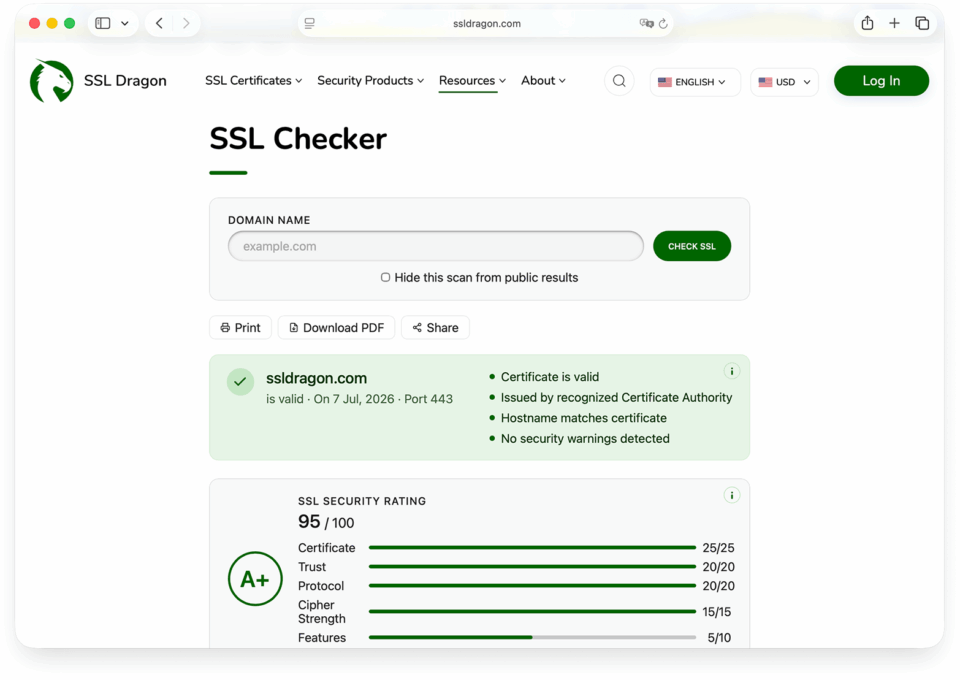
We’ve added a significant set of features to our SSL Checker. The tool still runs the same way, with no signup and no wait, but each scan now returns far more detail about your HTTPS setup. Here’s what’s new.
If you’ve ever generated a CSR, you’ve likely picked “RSA 2048” as the key type. Below is what that means: how the RSA algorithm works, a worked example you can check by hand, and which key size to choose. We also cover the September 2026 factoring records, which don’t threaten 2048-bit keys.
This guide compares PositiveSSL Wildcard vs EssentialSSL Wildcard and their single-domain versions, PositiveSSL vs EssentialSSL. All four are domain validation (DV) SSL/TLS certificates from Sectigo, formerly Comodo CA. That’s why some stores still list the wildcards as Comodo PositiveSSL Wildcard and Comodo EssentialSSL Wildcard. Others write Positive SSL and Essential SSL.
Sectigo and DigiCert are two of the largest commercial Certificate Authorities (CAs), and their prices are far apart. At SSL Dragon, a 1-year DigiCert OV certificate costs $230, while Sectigo OV SSL costs $110. Here’s what the extra money buys, and when it’s worth paying.
In this guide, you’ll learn how to install an SSL certificate on CentOS and its RHEL-family successors (AlmaLinux, Rocky Linux, and CentOS Stream) using the Apache httpd web server.
In this guide, you will learn how to install an SSL certificate on Apache, step by step. The instructions apply to Apache 2.4, the current stable release line.
You can generate a CSR in three places: on the command line with OpenSSL, inside your server’s control panel or admin console (cPanel, IIS, Plesk), or with our online tool if you don’t have server access. Whichever route you take, you fill in the same details about your domain and organization, and you end up with two […]
Installing an SSL certificate (technically a TLS certificate) means putting your issued certificate files on the server or platform that runs your website, then telling that server to use them. Once it’s done, your site loads over HTTPS with the padlock, and traffic between your visitors and your server is encrypted. The exact steps depend […]