



The Internet’s trust layer has come a long way since certificates lived quietly in the background. Back then, SSL wasn’t something teams tracked often. You bought a certificate, installed it on a server, and moved on.
If the site stayed up, trust was assumed. Browsers were forgiving, infrastructure changed slowly, and certificate management felt closer to housekeeping than a core operational concern.

A lot has shifted since then. The web got faster, messier, and far less forgiving. But one trend never blinked. SSL certificate validity has been shrinking steadily, like milk in the fridge: fine at first, then suddenly overdue before anyone notices.
As the web scaled, trust stopped being something you could grant once and leave untouched. More sites, more certificates, more automation, more opportunities for things to go wrong. Browsers tightened their rules, attackers adjusted, and the cost of a bad certificate skyrocketed.
Shortening validity became the go-to fix — a way to limit exposure without having to untangle every brittle system that had grown around certificate management.
How SSL Automation Became Inevitable
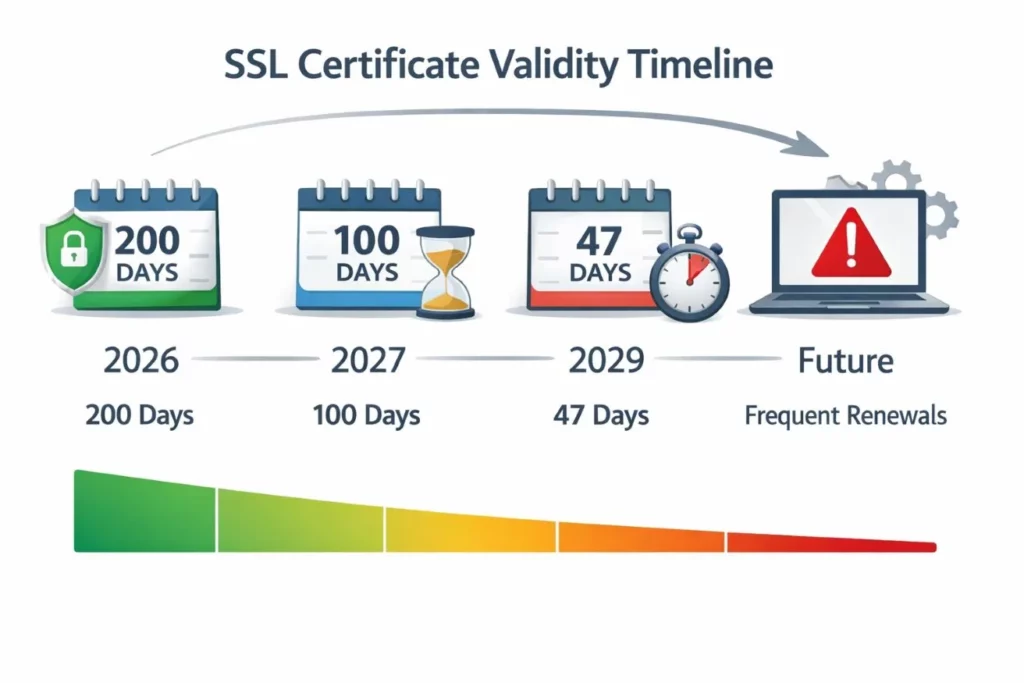
The CA/Browser Forum has set a clear trajectory: certificate validity will step down to 200 days from March 15, 2026, 100 days from March 15, 2027, and 47 days starting March 15, 2029. At that rate, manual certificate management is waiting for the deprecation notice.
For certificate authorities and browser vendors, the move is a no-brainer. Shorter lifetimes reduce cryptographic exposure and make mis-issued certificates less durable. But that’s only half the story.
The SSL ecosystem is tightly coupled, even if it doesn’t look that way at first glance. Browsers change a rule, CAs adjust their issuance, and suddenly everyone downstream feels the impact.
Reducing SSL validity is a perfect example. On its own, it’s an easy choice. But tell that to sysadmins who have hundreds of certificates to manage, and it suddenly becomes their worst nightmare.
One sysadmin reaction captured the mood bluntly:
“Lmao every company will have to hire a certificate-guy… need to pay for automated certificate management… most software still doesn’t support dynamic cert reloading.”
As the status quo built around slower cycles and longer margins for error vanishes, an avalanche of adjustments is about to hit the security teams.
How do you renew hundreds or thousands of certs on time, every time, without it turning into a constant emergency?
While people on forums and discussion boards anxiously search for a solution, ACME-based certificate issuance and renewal already provide it. You can request, validate, and renew SSL certs continuously, without human intervention, long before expiration becomes a worry.
On the surface, the industry is well-equipped to weather the upcoming “SSL validity” storm. Public statements around lifetime reductions consistently point to automation as the enabler — the thing that would keep trust reliable while certificates are turned over faster.
Tim Callan, Chief Compliance Officer at Sectigo and Vice Chair of the CA/Browser Forum, has framed the shift as inevitable:
“The industry’s unified support for reducing certificate lifespans to 47 days reflects a shared commitment to enhancing digital security and trust for all.”
But that framing isn’t universal. From inside cert operations, it rarely holds under real pressure. The issue isn’t automation itself — it’s everything that has to line up around it. And when validity shrinks, that margin disappears fast.
Compressed cycles only work if:
- Renewal succeeds every time — not just in staging
- Validation endpoints still resolve months after setup
- Failures surface early enough to fix without panic
When all of that lines up, automation feels invisible. When one thing slips, the system stalls, and by the time the error shows up, there’s no room left to maneuver.
The Hidden Cost of Moving Faster
At SSL Dragon, we manage thousands of certificate renewals across environments that weren’t designed for this pace. As validity windows shrink, we’re already seeing the early fractures, and they rarely start where people expect.
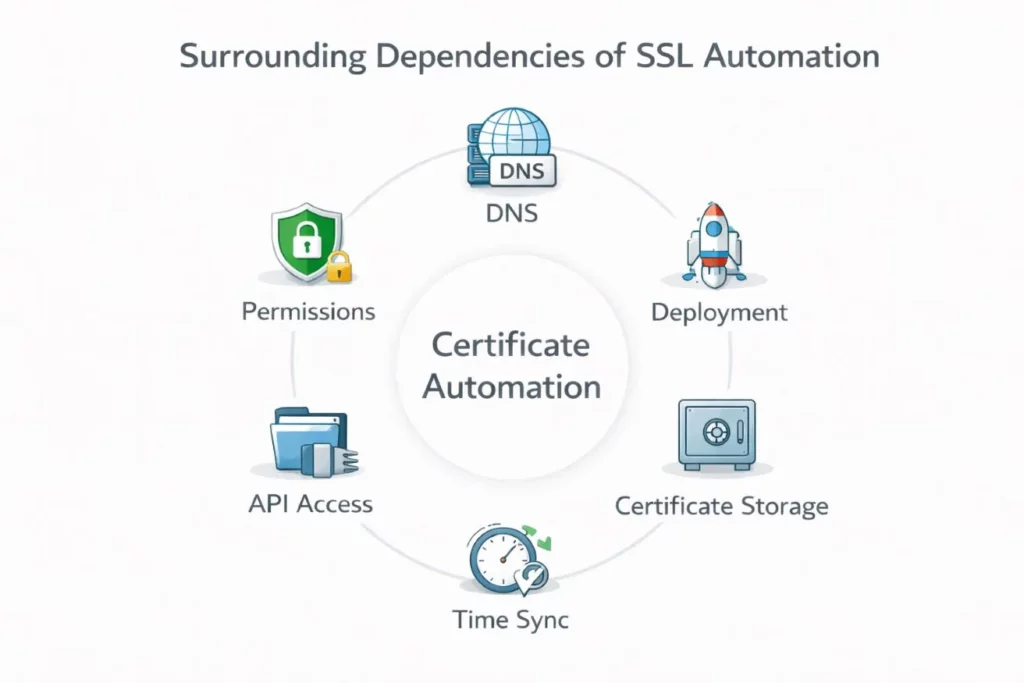
We’ve learned that the certificate itself is not the culprit. The real fragility lives in the systems around it:
- DNS records must stay correct and reachable
- Validation endpoints must resolve.
- Permissions granted months ago can’t silently expire.
- APIs must behave consistently.
- Time must stay in sync.
- Deployment tools must actually reload what gets renewed.
We’ve seen cases where the certificate was valid, issued, and in the right place, and the site still broke. The cause? A load balancer never picked it up. After a while, these don’t feel random. They follow patterns.
This is where the industry split around faster SSL turnover becomes clear.
Proponents of shorter validity are right: less lifetime means less exposure. But operators who’ve lived through failed renewals know the other side too well.
A renewal that fails once a year is manageable. The same failure every few weeks becomes a pattern. And patterns are harder to catch when the symptoms are brief and automated
Most outages we’ve seen weren’t caused by expiration but by upstream interference:
- A DNS change that seemed unrelated
- A load balancer that didn’t reload the cert
- A successful renewal that never made it into production
The certificate was valid. The chain was intact. And yet, the site was down.
Shorter lifetimes don’t eliminate these scenarios. They compress them. Failures surface closer to the edge, during renewal windows with little time to investigate or roll back. What used to be visible weeks in advance now appears hours before impact, sometimes minutes. The system doesn’t warn you by degrading gradually. It fails cleanly and all at once.
This is the part of the safety narrative that rarely gets discussed. Automation makes renewal reliable only if the environment around it is equally stable. When everything lines up, automation feels invisible and effortless.
But when one cog slips in an otherwise well-oiled system, the issue is no longer a missed calendar reminder. It is a chain reaction across systems that were never designed to be inspected every few weeks.
So the real question isn’t whether shorter lifetimes are good or bad.
It’s whether your systems are:
- Observable
- Testable
- Recoverable under pressure
Can you detect a silent renewal failure before production traffic feels it? Do you know which assumptions your automation stack depends on that didn’t even exist a year ago? And when one link in the chain snaps, how fast can you respond before trust breaks publicly?
For our support team, these are no longer theoretical questions. We’ve seen all three fail in real environments:
- A renewal passed, but no alert showed that it was never deployed
- A DNS zone was changed by another team, breaking validation — nobody noticed until the site went down
- A staging cert path was clean, but in prod, the web server hadn’t reloaded in weeks
In every case, automation was running, but no one was watching the edge conditions.
The lesson? It’s not enough to automate the renewal. You have to automate visibility. You have to know what the automation depends on and where failure will surface, long before your users do.
Moving faster isn’t free. It trades long-lived exposure for short-lived fragility. Shorter validity reduces one class of risk, but it introduces another that’s harder to see, and easier to underestimate. That’s the cost hiding behind the promise of safety.
Save 10% on SSL Certificates when ordering from SSL Dragon today!
Fast issuance, strong encryption, 99.99% browser trust, dedicated support, and 25-day money-back guarantee. Coupon code: SAVE10

What Shorter SSL Validity Demands in Practice
Shorter SSL validity forces a different level of operational maturity; one many environments weren’t built for. Automation can keep certificates rotating, but rotation isn’t the same as control. That gap gets overlooked more often than teams admit.
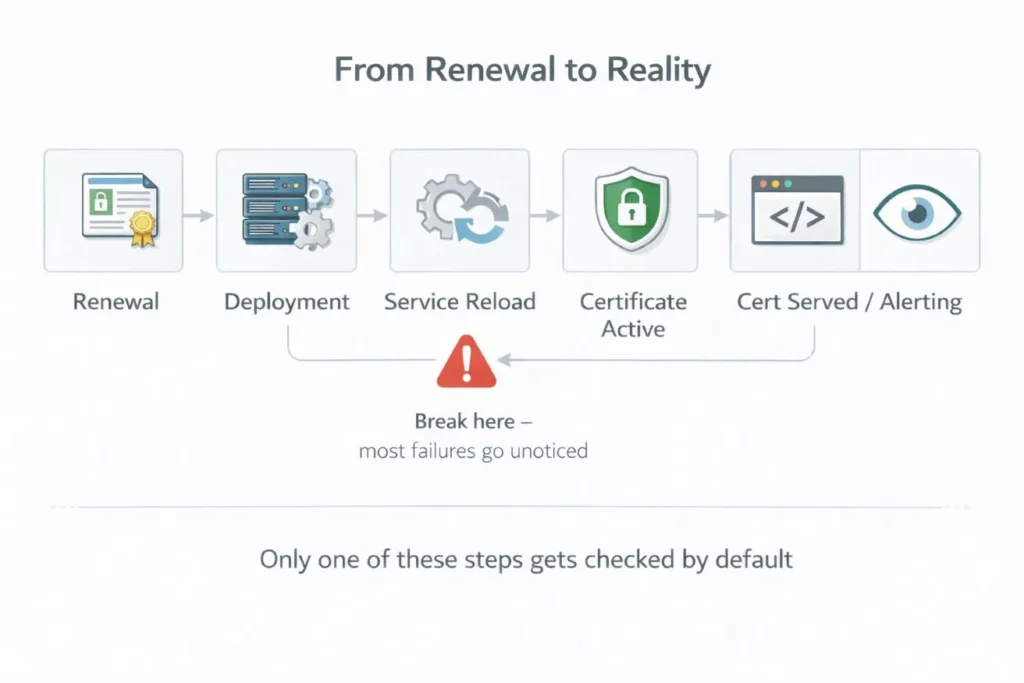
Too many setups treat renewal as the finish line.
If the certificate was issued, the job is considered done. But in reality, that’s just one link in a longer chain:
- The cert has to be deployed to the correct path
- Reloaded by the correct service
- And actively served to users
- Ideally, it should be monitored after deployment
Shorter lifespans compress the steps and reduce your window to catch a misstep before it spreads.
Automation Ran, But Did the Cert Land?
What faster cycles really demand is visibility. Not just a green checkmark saying “renewed,” but confidence that the right certificate is in production and actually being used.
In practice, we’ve seen that visibility is missing. Teams know a renewal job ran, but not whether the new cert replaced the old one everywhere it needed to. In complex setups (reverse proxies, clusters, load balancers), that gap can stay hidden until something breaks.
Testing Becomes Harder to Ignore
Renewal paths work fine for months… until they don’t.
- A DNS record gets updated by another team
- A validation endpoint is removed during cleanup
- A permission quietly changes
None of those trigger alerts by default. They only surface when renewal hits them. And with shorter validity, that hit comes faster, with less room to respond.
Recovery Is the Other Pressure Point that’s Exposed
When certs last a year, a failed renewal gives you time to investigate, escalate, and recover. With 90-day certs? You’re already in the impact window. With 47-day certs? It’s already urgent.
The operational bar has moved. Certificate management has shifted from a quiet maintenance task to a production-level responsibility, with its own failure modes, dependencies, and recovery logic.
And here’s the uncomfortable part: automation makes all of this possible, but also easier to overlook. When everything works, no one inspects it. That’s exactly when ownership slips.
Who Feels the Pressure First?
Who feels this shift depends less on certificate counts and more on how ownership is structured inside the organization.
Smaller Teams
Smaller companies often feel the pressure first, not from a lack of skill, but from missing redundancy. One or two people may be responsible for everything from DNS to server configuration to certificate renewal.
When something breaks, the context lives in someone’s head, and shorter lifetimes leave less time to piece it together before users feel it.
Large Organizations
Larger setups face a different problem. Certificate management is often distributed across teams. DNS ownership sits with one group. Servers with another. Load balancers with a third.
Certificates may be issued automatically, but responsibility for deployment and validation is fragmented. In those environments, certificate failures belong to the gap between teams.
Legacy Systems
Legacy infrastructure also absorbs the change differently than modern platforms. Systems built around static configuration and infrequent updates struggle when certificates rotate faster than their reload mechanisms were designed to handle.
In contrast, platforms built with frequent change in mind tend to adapt more smoothly. The difference isn’t tooling alone. It’s whether certificate turnover was considered a normal operational event or an edge case.
What’s Actually Changed?
What makes this shift important is that execution issues have become more public and less forgiving. Browsers don’t degrade gracefully. Users don’t distinguish between certificate errors and outages. When trust breaks, it breaks loudly, regardless of how subtle the root cause was.
That’s why the conversation around shorter SSL validity can’t stop at renewal frequency or automation support. The real question is whether teams understand where certificate risk now lives. It no longer sits primarily in forgotten expiration dates but in the paths that renewal depends on and the systems that are expected to react correctly every time.
Shorter validity reduces exposure in one dimension while increasing sensitivity in another. It rewards environments that are predictable and coordinated, but punishes those who rely on assumptions and long buffers.
The promise of safety isn’t false. But it isn’t free either. And the cost shows up not in theory, but in the day-to-day mechanics of how trust is maintained when there’s less time to recover from being wrong.
Save 10% on SSL Certificates when ordering from SSL Dragon today!
Fast issuance, strong encryption, 99.99% browser trust, dedicated support, and 25-day money-back guarantee. Coupon code: SAVE10