



For over three decades, SSL and TLS protocols have protected billions of online transactions. What started as Netscape’s ambitious security project in 1994 evolved into today’s sophisticated encryption standards. This SSL history spans six major protocol versions, countless security improvements, and a fundamental shift in how we think about web security.
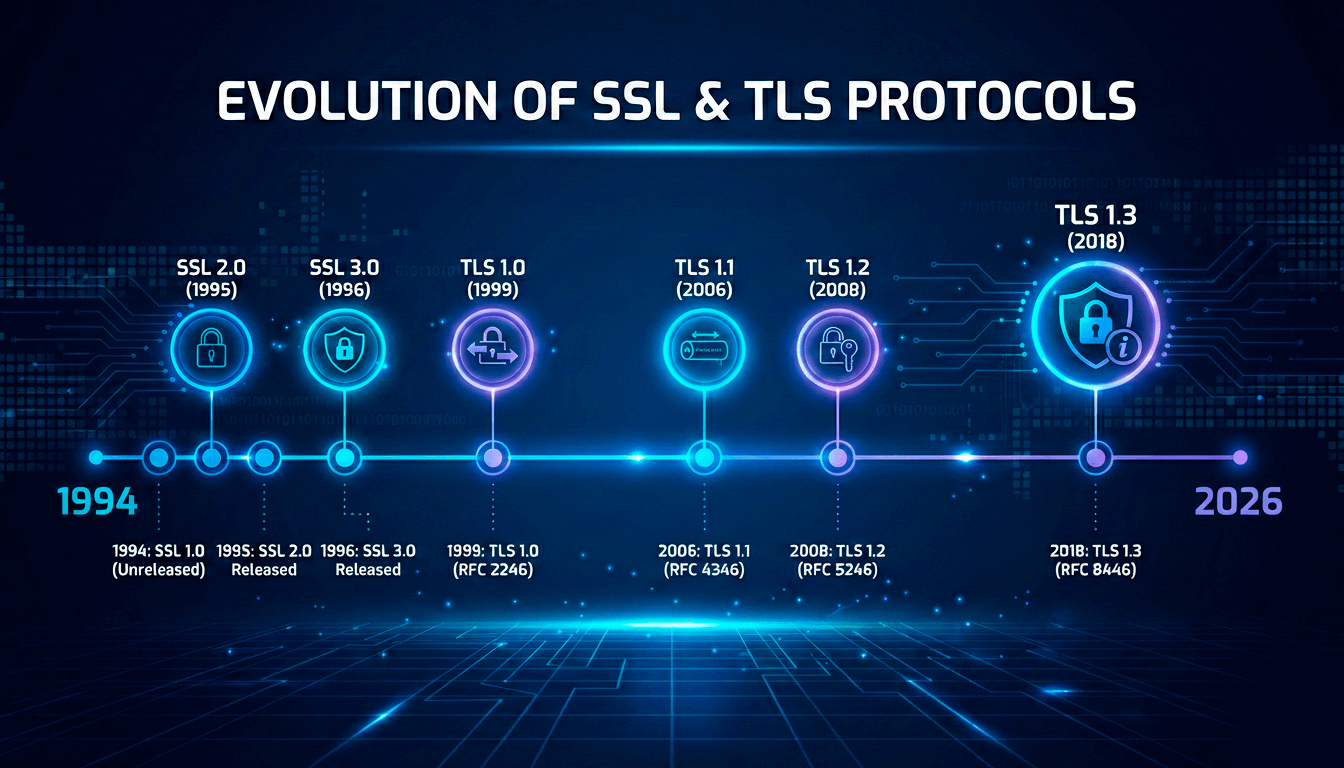
Understanding SSL/TLS versions isn’t just about knowing which protocols are deprecated. It’s about recognizing how each vulnerability, attack, and breakthrough shaped the current landscape where TLS 1.3 secures 95% of encrypted web traffic.
Table of Contents
- The Birth of SSL Protocol at Netscape
- SSL 3.0 – A Complete Protocol Redesign
- TLS 1.0 – The IETF Standardization Era
- TLS 1.1 and TLS 1.2 – Incremental Security Enhancements
- TLS 1.3 – The Modern Security Standard
- Common Misconceptions About SSL/TLS Versioning
- The Role of Certificate Authorities in SSL/TLS Evolution
- Industry Milestones That Shaped HTTPS Adoption
- Major Security Vulnerabilities That Drove Protocol Evolution
- Future of SSL/TLS Protocols
Save 10% on SSL Certificates when ordering from SSL Dragon today!
Fast issuance, strong encryption, 99.99% browser trust, dedicated support, and 25-day money-back guarantee. Coupon code: SAVE10

The Birth of SSL Protocol at Netscape
SSL 1.0 – The Unreleased First Attempt (1994)
Taher Elgamal, Netscape‘s chief scientist, designed the original Secure Sockets Layer in 1994. But SSL 1.0 never saw the light of day. Security researchers at Netscape discovered critical flaws before the public release, vulnerabilities serious enough to scrap the entire version.
The lesson was clear: cryptographic protocols need extensive review before deployment. This setback, though frustrating, established a pattern of rigorous testing that would define future SSL and TLS development.
SSL 2.0 – The First Public Release (1995)
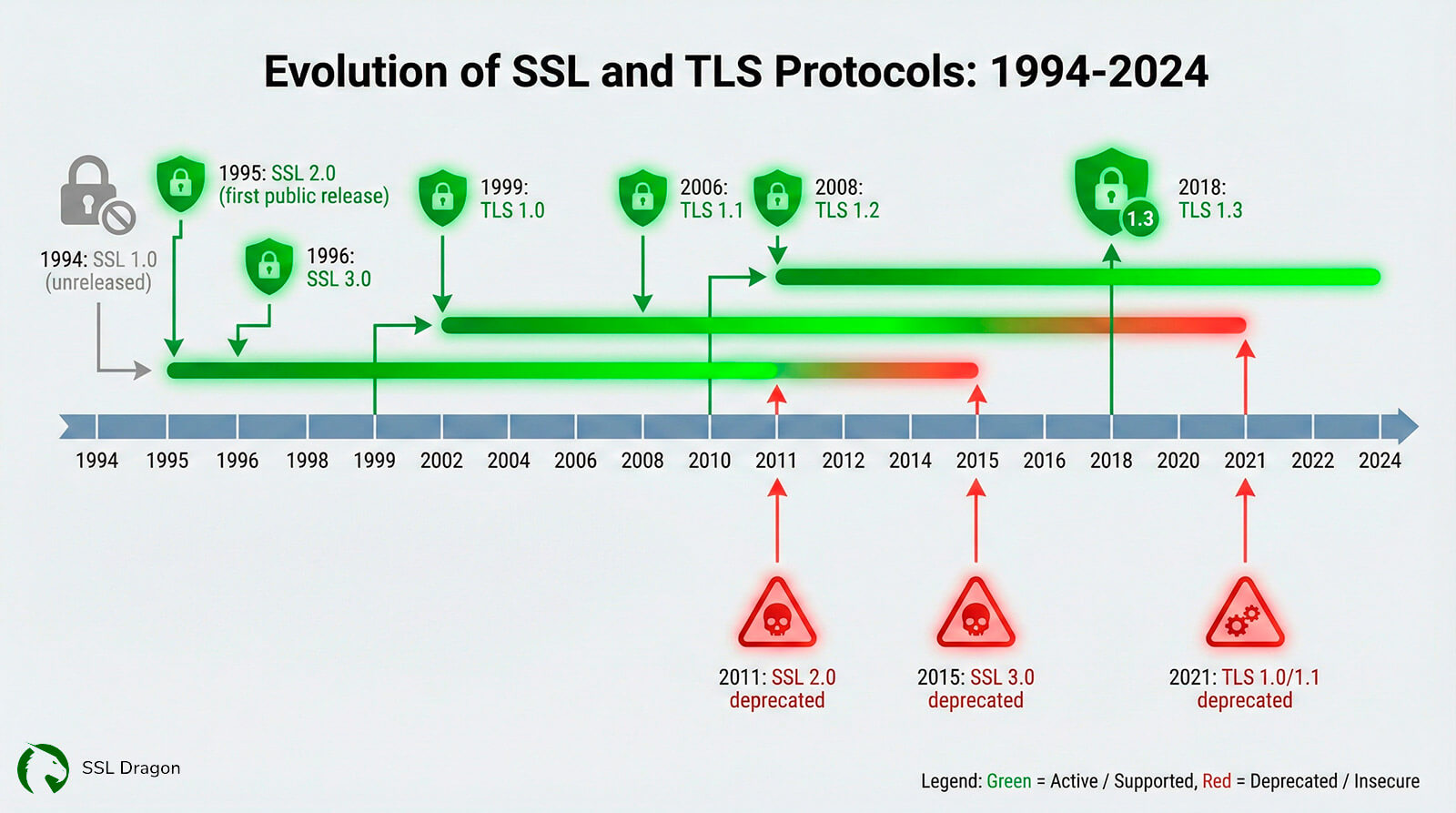
When did SSL come out? The answer is February 1995, when Netscape bundled SSL 2.0 with Navigator 1.1. This SSL version introduced foundational concepts still used today: the SSL handshake process, X.509 digital certificates, and server authentication.
But SSL 2.0 had problems. It relied on MD5 for message authentication, used the same key for encryption and authentication, and lacked protection for the handshake itself. Attackers could downgrade connections to weaker 40-bit encryption without either party noticing.
The IETF officially deprecated SSL 2.0 in March 2011 through RFC 6176. By then, most servers had already moved on.
SSL 3.0 – A Complete Protocol Redesign
Major Improvements Over SSL 2.0 (1996)
Paul Kocher, Phil Karlton, and Alan Freier completely rewrote the SSL protocol for version 3.0, released in November 1996. They separated the data transport layer from the message layer, added support for Diffie-Hellman key exchange and Fortezza cipher suites, and implemented proper 128-bit keying.
SSL 3.0 also introduced record compression and a more flexible cipher suite negotiation. The IETF later documented it in RFC 6101, recognizing its historical importance. For nearly two decades, SSL 3.0 served as a fallback option for legacy systems.
The POODLE Vulnerability and SSL 3.0 Deprecation
In October 2014, Google’s security team discovered POODLE (Padding Oracle on Downgraded Legacy Encryption). The attack exploited how SSL 3.0 handled cipher block chaining (CBC) mode padding. Attackers could decrypt secure HTTP cookies by forcing browsers to downgrade from TLS to SSL 3.0.
The IETF responded quickly, deprecating SSL 3.0 in June 2015 via RFC 7568. This marked the end of the SSL era. When people ask about the “latest SSL version,” the answer is SSL 3.0, because SSL itself was never updated again. The torch had passed to Transport Layer Security.
TLS 1.0 – The IETF Standardization Era
From SSL to TLS Transition (1999)
By the late 1990s, the IETF wanted to standardize internet security protocols. Tim Dierks and Christopher Allen led the effort to transform SSL into an open standard. Microsoft and Netscape negotiated the naming—Transport Layer Security was the compromise that stuck.
TLS 1.0, published as RFC 2246 in January 1999, was essentially SSL 3.1 with a new name. The differences were minor but meaningful enough to break compatibility. You couldn’t mix SSL 3.0 clients with TLS 1.0 servers without careful implementation.
Key Differences from SSL 3.0
TLS 1.0 upgraded the underlying cryptography. It replaced SSL’s custom message authentication code (MAC) with HMAC, standardized by cryptographers. The key derivation function changed to prevent certain theoretical attacks. The alert system expanded with more specific error codes.
TLS 1.0 also required support for DSS/DH cipher suites, giving implementations more flexibility. These changes seemed small, but they reflected a shift from proprietary development to community-driven standardization. The IETF now controlled the protocol’s evolution.
TLS 1.1 and TLS 1.2 – Incremental Security Enhancements
TLS 1.1 Protection Against CBC Attacks (2006)
Released in April 2006 through RFC 4346, TLS 1.1 addressed specific CBC vulnerabilities. The biggest change? Explicit initialization vectors (IVs) replaced implicit IVs. This prevented attackers from predicting the IV and exploiting cipher block chaining.
TLS 1.1 also improved error handling for padded records. Instead of revealing specific padding errors, it returned a generic bad_record_mac alert. These changes protected against BEAST (Browser Exploit Against SSL/TLS), discovered years later in 2011.
IANA parameter registries were established, making cipher suite management more organized. But adoption was slow. Many organizations skipped TLS 1.1 entirely, waiting for TLS 1.2‘s more substantial improvements.
TLS 1.2 Enhanced Flexibility (2008)
When was TLS 1.2 released? August 2008, via RFC 5246. This update brought the most significant changes since SSL 3.0. The protocol switched from hardcoded MD5/SHA-1 combinations to cipher-suite-specified pseudorandom functions (PRFs). SHA-256 became the new standard.
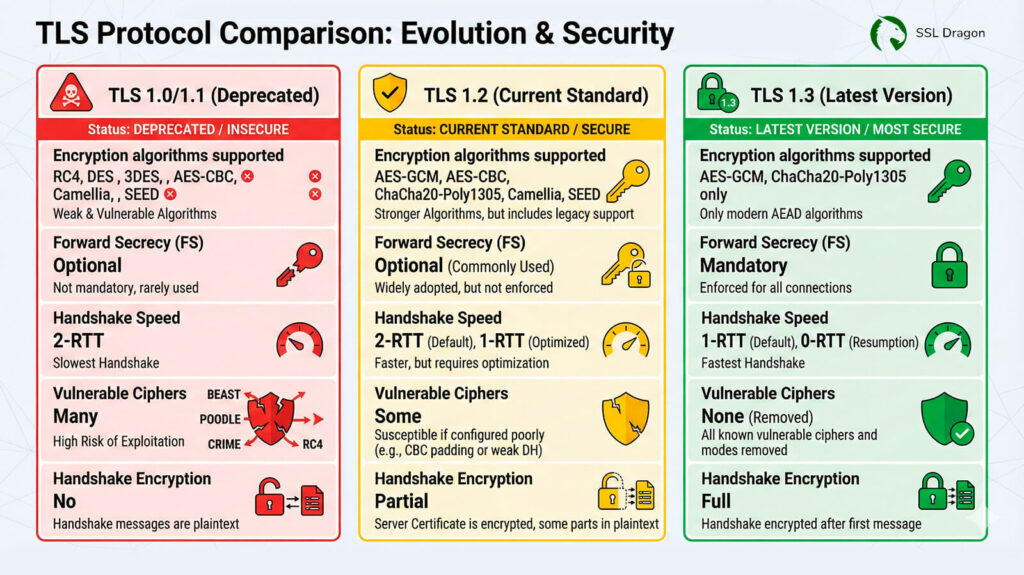
TLS 1.2 introduced authenticated encryption with additional data (AEAD) cipher modes, including AES-GCM and ChaCha20-Poly1305. It gave implementations flexibility in choosing hash and signature algorithms. This adaptability proved crucial as cryptographic standards evolved.
The protocol remains widely deployed today. Around 95.8% of websites still support TLS 1.2, often running alongside TLS 1.3. In March 2021, the IETF jointly deprecated TLS 1.0 and 1.1 through RFC 8996, making TLS 1.2 the minimum acceptable standard.
Save 10% on SSL Certificates when ordering from SSL Dragon today!
Fast issuance, strong encryption, 99.99% browser trust, dedicated support, and 25-day money-back guarantee. Coupon code: SAVE10
TLS 1.3 – The Modern Security Standard
Five Years in Development (2018)
TLS 1.3 took a decade to arrive. The IETF published RFC 8446 in August 2018 after 28 drafts and extensive collaboration. Simplicity and performance drove the redesign. The working group removed legacy features, simplified the handshake, and eliminated entire classes of vulnerabilities.
Google, Mozilla, Microsoft, and Apple quickly added support. By 2019, all major browsers could negotiate TLS 1.3 connections. Cloudflare and other CDN providers enabled it by default. The latest TLS version didn’t just improve security, it made encrypted connections faster.
Revolutionary Security Improvements
TLS 1.3 removed everything broken or weakened. SHA-1, MD5, RC4, DES, and 3DES cipher suites? Gone. Static RSA and Diffie-Hellman key exchange? Eliminated. The protocol now requires perfect forward secrecy using ephemeral Diffie-Hellman for all connections.
The handshake changed fundamentally. Every message after ServerHello is encrypted, hiding the negotiation from prying eyes. The key derivation function switched to HMAC-based Extract-and-Expand (HKDF), providing better cryptographic guarantees.
TLS 1.3 also introduced 0-RTT (zero round-trip time) mode. Clients can send encrypted data on the first message to previously contacted servers, eliminating handshake latency. The simplified state machine made implementations less error-prone. ECC moved into the base specification with new signature algorithms like RSA-PSS.
Current Adoption and Coexistence
What’s the latest TLS version? TLS 1.3 holds that title. But TLS 1.2 isn’t going anywhere soon. Organizations need time to upgrade servers, test compatibility, and update client software. Most security-conscious sites now support both, letting clients choose the best available option.
The coexistence works well. Servers negotiate the highest mutually supported version. Clients that can’t handle TLS 1.3 fall back to TLS 1.2. This gradual migration approach prevents the compatibility disasters that plagued earlier transitions.
Common Misconceptions About SSL/TLS Versioning
Why There’s No TLS 2.0
What’s the TLS 2.0 release date? There isn’t one. TLS 2.0 doesn’t exist and never will. The IETF uses incremental versioning: TLS 1.0, 1.1, 1.2, 1.3. The next version, if it comes, will be TLS 1.4 or possibly TLS 2.0, but skipping directly to “TLS 2.0” after SSL 3.0 would have caused massive confusion.
People often expect protocols to use major version numbers (like software that jumps from version 1 to version 2). But cryptographic protocols evolve more conservatively, with each release building on the previous one.
SSL vs. TLS Terminology
Ask for an “SSL certificate” and you’ll get a certificate that works with TLS 1.2 and TLS 1.3. The industry still uses “SSL” in marketing because it’s familiar. Even though the current SSL version is technically nonexistent (SSL ended at version 3.0), the term stuck.
Certificate authorities like DigiCert and Sectigo sell “SSL certificates” that exclusively use TLS protocols. It’s confusing but harmless. Just remember: when someone mentions SSL in 2026, they almost certainly mean TLS.
The Role of Certificate Authorities in SSL/TLS Evolution
Validation Types Development
Early SSL certificates were expensive and slow. Business Validation required days or weeks of manual verification. In 2002, GeoTrust introduced Domain Validation, automating the process by verifying domain ownership through email or DNS records.
Extended Validation certificates arrived in 2007, promising the highest assurance with green address bars in browsers. Let’s Encrypt launched in 2015, offering free Domain Validation certificates through automated issuance. Cloudflare followed with their own free certificate program. These changes democratized HTTPS, making encryption accessible to small websites.
Certificate Validity Period Reduction
Certificate validity periods kept shrinking. The baseline requirements dropped maximum validity from five years to three in 2015. Two years became the limit in 2018. Apple’s Safari enforced a one-year maximum in 2020, forcing other browsers to follow.
Now the industry is pushing toward an even shorter certificate lifecycles. The CA/Browser Forum has defined a clear reduction in certificate validity periods: 200 days starting March 15, 2026, 100 days from March 15, 2027, and just 47 days by March 15, 2029.
This shift makes manual certificate management impractical, pushing organizations toward automated solutions like ACME-based Certificate-as-a-Service (CaaS), where validation, issuance, and renewal are handled automatically.
Industry Milestones That Shaped HTTPS Adoption
Google’s HTTPS Push
In August 2014, Google announced HTTPS as a ranking signal. This single decision changed SSL history. Webmasters who ignored encryption suddenly had business reasons to care. By 2016, half of all web traffic was encrypted.
Chrome 68 took the next step in July 2018, marking all HTTP sites as “Not Secure.” The warning appeared in the address bar for every unencrypted page. Today, over 95% of web traffic uses HTTPS. Google turned encryption from a security best practice into a business requirement.
Browser Security Indicators Evolution
Remember Extended Validation’s green address bar? It’s gone. Chrome removed it in 2020 after research showed users didn’t notice or understand it. The padlock icon itself is disappearing, replaced by neutral indicators that normalize HTTPS rather than reward it.
Chrome 69 removed the “Secure” text, leaving just the padlock. Current browsers focus on warning about insecure connections rather than praising secure ones. The message: HTTPS is the default expectation, not something special.
Major Security Vulnerabilities That Drove Protocol Evolution
Notable Attacks on SSL/TLS
POODLE hit SSL 3.0 in 2014, exploiting padding oracle vulnerabilities in CBC mode. Attackers could decrypt secure cookies by downgrading connections and repeatedly modifying ciphertext. The attack killed SSL 3.0 within months.
BEAST targeted TLS 1.0 in 2011, using a similar CBC weakness. Attackers could decrypt HTTPS cookies by injecting client-side code and observing encrypted responses. The fix required implementing explicit IVs in TLS 1.1.
BREACH abused HTTP compression in 2013. The attack didn’t target the TLS protocol itself but showed how application-layer decisions affect security. Heartbleed, discovered in 2014, exposed a critical OpenSSL implementation bug that leaked private keys and user data.
Both are old news, but outdated servers still get flagged for them today. Scan for TLS vulnerabilities on your own domain to confirm Heartbleed, POODLE and other legacy issues aren’t still exposed.
Lessons Learned
Each vulnerability proved the same point: backward compatibility is dangerous. Keeping old protocols alive for legacy systems creates attack vectors. The industry learned to deprecate aggressively and force upgrades.
Security researchers deserve credit too. Public disclosure of vulnerabilities accelerated improvements. Without POODLE, SSL 3.0 might still be lurking in server configurations today.
Future of SSL/TLS Protocols
Post-Quantum Cryptography
Quantum computers threaten current encryption algorithms. RSA and elliptic curve cryptography could become obsolete once quantum machines achieve sufficient scale. NIST is standardizing post-quantum algorithms designed to resist quantum attacks.
TLS will need updates to support these quantum-resistant algorithms. The transition won’t be easy, post-quantum cryptography uses larger keys and different mathematical approaches. But the protocol evolution that brought us from SSL 2.0 to TLS 1.3 proved the community can handle major transitions.
Emerging Technologies
DTLS (Datagram Transport Layer Security) extends TLS to UDP connections. QUIC, developed by Google and standardized by the IETF, integrates encryption directly into the transport layer. These protocols build on TLS’s cryptographic foundations while adapting to different use cases.
Blockchain-based alternatives like Remme experiment with distributed PKI. Certificate authorities continue evolving, automating more processes and supporting shorter validity periods. What comes after TLS 1.3? Probably incremental improvements rather than a complete redesign. TLS 1.3 got most things right.
Stay Current with SSL Dragon’s TLS 1.3-Ready Certificates
Understanding protocol evolution is one thing. Implementing modern encryption standards is another. SSL Dragon provides digital certificates fully compatible with TLS 1.3 and TLS 1.2, supporting the latest cryptographic protocols and cipher suites.
We offer fast issuance, strong encryption, and 99.99% browser trust through partnerships with leading certificate authorities including DigiCert, Sectigo, and GeoTrust. Our automated certificate management solutions help you handle upcoming 47-day lifecycles without manual renewal hassles.
Migrating from deprecated protocols? Our dedicated support team guides you through the transition. Every purchase includes a 25-day money-back guarantee. Explore our certificate portfolio today and secure your infrastructure with the latest TLS version.
Save 10% on SSL Certificates when ordering from SSL Dragon today!
Fast issuance, strong encryption, 99.99% browser trust, dedicated support, and 25-day money-back guarantee. Coupon code: SAVE10