



The SSL industry already has one countdown on the wall. By 2029, the old annual renewal rhythm will be gone. Certificates will expire faster, automation will be mandatory, and businesses still running on calendar reminders will fall behind. That challenge, at least, is legible. The harder problem is not about time. It’s about visibility.
Post-quantum cryptography will eventually force every organization to answer a question most have never seriously asked: where, exactly, is cryptography running? Not just the website certificate, but the TLS handshakes, signed software, email identity, document workflows, private PKI, vendor dependencies, and legacy infrastructure that still works because nobody has had to question it.
From SSL Dragon’s view of the certificate market, this matters because certificates are no longer only a purchase decision. They are becoming a lifecycle, automation, and trust-management problem across TLS, S/MIME, code signing, document signing, and private infrastructure. That is the terrain this editorial maps.
Table of Contents
- Every Certificate Carries a Cryptographic Bet
- The Standards Are Already Here
- Chrome Is Not Treating This Like a Normal Upgrade
- Bigger Math Means Heavier Trust
- The Hardest Part May Be Signatures, Not Encryption
- What You Should Do Before the “Quantum-Safe” Label Arrives
- The Clock Is Shorter, but the Work Is Deeper
Every Certificate Carries a Cryptographic Bet
A missed renewal announces itself. A weak cryptographic dependency does not.
Expired certificates fail in public: browser warnings, broken checkouts, failed logins, urgent tickets. Cryptographic debt is quieter. It settles into aging libraries, signing systems, VPNs, internal APIs, and private infrastructure.
An SSL/ TLS certificate is more than a file. It’s a signed statement of trust, asserting that a public key belongs to a specific identity, that a certificate authority was permitted to make that claim, and that the algorithms behind the signature remain strong enough for browsers, servers, and operating systems to accept. That last condition is not a guarantee. It is a bet.
The Bet that Felt Safe
For decades, the bet felt invisible because it kept paying out. RSA and ECDSA cryptography became digital infrastructure in the truest sense: load-bearing, omnipresent, and noticed only in failure. They underpin HTTPS, encrypted email, signed software, document integrity, machine identities, and vast stretches of private enterprise architecture. Most users never encounter the math behind them.
Post-quantum cryptography does not break that picture today. It unsettles the assumption beneath it. The pressure is not a quantum computer cracking live certificates. It’s the migration that follows when vulnerable algorithms must eventually be replaced.
At that moment, organizations will need precise answers:
- Which systems can move cleanly, which vendors control the update path?
- Which legacy infrastructure is too rigid to change on a reasonable timeline?
Shorter certificate lifetimes tighten the renewal clock. Post-quantum migration questions whether the clock was ever the right thing to be watching.
The Standards Are Already Here
Post-quantum cryptography means replacing public-key algorithms such as RSA and ECDSA with alternatives designed to resist attacks from future quantum computers
It used to sound like a problem for research labs and defense planners, people professionally paid to think about several disasters ahead. That stage is over.
In August 2024, the National Institute of Standards and Technology (NIST) finalized its first post-quantum cryptography standards, completing an eight-year process that evaluated 82 algorithms submitted by researchers across 25 countries.
Three emerged and became the official foundation for a quantum-resistant future.
- ML-KEM for key establishment
- ML-DSA for digital signatures
- SLH-DSA as a stateless hash-based alternative
NIST standards carry institutional gravity. They shape what governments require, what vendors build toward, what auditors enforce, and what browsers and certificate authorities prepare for. When NIST moves, the industry eventually follows.
Dustin Moody, the mathematician who led the standardization effort, was direct about urgency when the final standards were announced. System administrators, he said, should begin integrating the new standards now because full migration across real infrastructure will take years.
That is honest framing. No organization needs to replace every certificate this quarter. But the scale of what must eventually change is enormous: TLS, S/MIME, code signing, document integrity, software updates, private PKI, device authentication, and every system that uses public-key cryptography to establish trust. Delay becomes its own form of risk when the map is that large.
The question that once dominated this conversation was speculative: might quantum computers eventually break today’s cryptography? That question has not disappeared, but it is no longer the only one that matters.
The harder question is now practical: what happens when the tools securing modern digital trust must be replaced across systems that were never designed to change?
Chrome Is Not Treating This Like a Normal Upgrade
The clearest signal that post-quantum cryptography is not a routine algorithm swap comes from the browser that sets the pace for everyone else.
In February 2026, Google announced that Chrome has no immediate plan to add traditional X.509 certificates containing post-quantum algorithms to its Root Store.
Save 10% on SSL Certificates when ordering from SSL Dragon today!
Fast issuance, strong encryption, 99.99% browser trust, dedicated support, and 25-day money-back guarantee. Coupon code: SAVE10

Instead, the team is developing Merkle Tree Certificates through the IETF PLANTS working group, a structurally different approach to the problem. The reason is not philosophical.
Quantum-resistant cryptography produces significantly larger signatures, and when Certificate Transparency requirements enter the picture, that added weight creates real performance and bandwidth pressure.
If stronger math were all this transition required, Chrome would simply accept stronger certificates. It is not doing that.
When Transparency Meets Weight
Certificate Transparency made the web meaningfully safer by turning certificate issuance into a publicly auditable record. It also created a system that must scale globally and perform under every real-world condition: weak mobile connections, enterprise firewalls, aging devices, and infrastructure where latency is not an abstraction but a customer complaint.
Post-quantum signatures strain that architecture. Trust data grows larger. Verification becomes heavier. And a TLS handshake that adds friction at the wrong moment does not announce itself as a cryptographic engineering problem. Users have no patience for certificates that are more future-proof but slower to prove it.
That is the tension Google is working through, and it reframes what the next certificate challenge actually demands. Quantum resistance is not only about trust strength, but whether that trust can still be delivered at the speed the modern web requires.
Bigger Math Means Heavier Trust
The size problem is not theoretical, but arithmetic. Today’s ECDSA signature on a 256-bit curve is commonly represented as two 32-byte values before encoding overhead.
ML-DSA-65, one of NIST’s new post-quantum standards, carries a public key of 1,952 bytes and a signature of 3,309 bytes. Certificate size varies with encoding, extensions, and chain structure, but the direction is clear: post-quantum cryptography adds kilobytes where the web’s trust infrastructure was built around far smaller objects. At scale, bytes become policy.
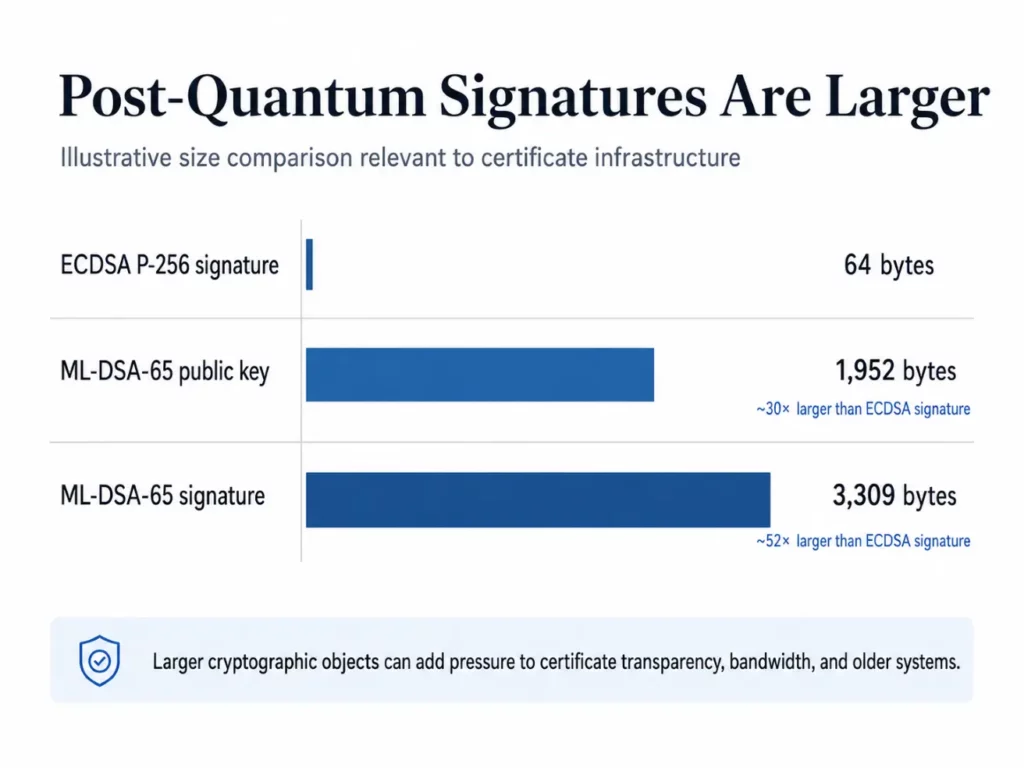
A few extra kilobytes across a single connection is a rounding error. Across billions of HTTPS handshakes running through mobile networks, corporate proxies, CDNs, certificate logs, and devices still carrying infrastructure decisions from a decade ago, the arithmetic compounds into something that cannot be waved away.
This is precisely why Chrome is exploring alternatives to simply inserting post-quantum signatures into traditional X.509 certificates. The container was not designed for this payload.
Stronger is not the Same as Deployable
The UK’s National Cyber Security Centre frames the trade-off plainly. Larger post-quantum parameter sets offer higher security margins, but they demand more processing power and bandwidth in return. For most real-world deployments, the NCSC recommends ML-KEM-768 and ML-DSA-65, because they represent the most protection an actual network can be expected to carry reliably.
The web is not a controlled environment. It’s phones, routers, payment terminals, school networks, airport Wi-Fi, enterprise middleboxes, and SaaS platforms running on architectural choices made before post-quantum was anyone’s budget line. The goal was never the strongest possible algorithm, but the most efficient one the real world would actually use.
The Hardest Part May Be Signatures, Not Encryption
Encryption gets the headlines because secrecy is intuitive. A message is protected or it is not. But certificates also sit at the center of something less visible and arguably more consequential: digital signatures. Broken encryption exposes data. Broken signatures corrupt belief.
The Industry Has Seen this Failure Mode Before.
In 2011, the Dutch certificate authority DigiNotar was breached, and fraudulent certificates were issued for hundreds of domains, including Google and Skype. Browsers pulled their trust. The Dutch government intervened. DigiNotar went bankrupt. What the incident demonstrated is that certificate trust does not fail in isolation. When it goes, it goes fast, and ordinary users are the last to understand why.
That history is worth holding when considering what post-quantum migration demands of signatures specifically. NIST standardized ML-DSA and SLH-DSA alongside ML-KEM precisely because key establishment and authentication are distinct problems requiring distinct solutions.
The NCSC notes that hash-based schemes like SLH-DSA, LMS, and XMSS carry larger signatures and slower performance, making them unsuitable for general use but reasonable candidates for firmware and software signing, where throughput pressure is lower.
The distinction shows something the TLS-focused conversation often misses.
- A website certificate secures a connection.
- An S/MIME certificate secures identity in the inbox.
- A code-signing certificate protects the path between developer and end user.
- A document certificate preserves the integrity of a file long after it has left its author’s hands.
These are different instruments serving various functions across systems, and every one of them rests on the same foundation: a signature that the world agrees to believe.
What You Should Do Before the “Quantum-Safe” Label Arrives
The organizations that handle this well will not be the ones chasing quantum-safe product labels. They will already know where their cryptography functions.
That work is routine: inventory, ownership, vendor planning, crypto agility. But it is the only foundation that holds.
Start With the Map
Most organizations know their public-facing certificates. Far fewer have a clear picture of everything else: internal certificates, signing systems, machine identities, and vendor-controlled infrastructure quietly doing cryptographic work in the background.
A useful inventory asks four things:
- Which certificates are active, and who owns them?
- Which systems depend on S/MIME, code signing, private PKI, VPNs, APIs, or device authentication?
- Which vendors control the update path, and do they have a credible roadmap?
- Which systems are too brittle to survive another migration cleanly?
Once the map exists, risk sets the order. A marketing site and a firmware-signing pipeline do not belong on the same timeline.
Hybrid PKI Is Not the Comfortable Middle Ground It Sounds Like
Many organizations will expect a gentle overlap: traditional and post-quantum methods running in parallel until the transition settles. Inside PKI, that assumption gets expensive fast.
The NCSC is direct: hybrid authentication within PKI is considerably harder than hybrid key establishment. A single algorithm swap is rarely possible in isolation. The options are a PKI that handles both signature types simultaneously, or two parallel PKIs. Neither is a minor undertaking.
The NCSC’s own preference is a clean migration to fully post-quantum PKI over building hybrid architecture that adds complexity without resolving the underlying problem.
Crypto Agility Is a Practice, Not a Feature
Systems should rotate keys, swap algorithms, update libraries, and replace certificates without a full rebuild each time. Organizations that rediscover their own infrastructure during every cryptographic transition will find this decade costly.
Shorter certificate lifetimes are quiet preparation for exactly this. Businesses already automating renewal and tracking ownership are building the discipline post-quantum migration demands, not because automation solves the quantum problem, but because it builds the right reflex: trust infrastructure managed continuously, not rescued when something breaks.
The Clock Is Shorter, but the Work Is Deeper
Shorter certificate validity is the challenge everyone can see. It will force more businesses toward automation and punish manual workflows built on memory, calendar reminders, or one person who knows where everything lives.
Post-quantum cryptography points to the deeper test: whether businesses understand the certificates, signatures, keys, vendors, devices, and internal systems their trust depends on.
A 47-day certificate changes how fast organizations must move. Post-quantum migration – how deeply they must look.
Manage Certificates With Less Guesswork
SSL Dragon helps businesses choose, issue, renew, and manage TLS, S/MIME, code signing, and document signing certificates. With clear guidance, fast support, and years of certificate experience, we make digital trust easier to handle before it becomes a problem.
Save 10% on SSL Certificates when ordering from SSL Dragon today!
Fast issuance, strong encryption, 99.99% browser trust, dedicated support, and 25-day money-back guarantee. Coupon code: SAVE10