



SSL certificate validity is changing, and the shift has already started. The industry is moving away from long-lived certificates and toward much shorter lifetimes, forcing a different approach to how you manage SSL/TLS.

This is not a minor update. Reduced SSL validity increases the frequency at which you issue certificates, validate domains, and handle renewals. Processes that worked on yearly cycles no longer hold under tighter timelines.
This article explains what changed, why the industry made this move, and what it means in practice. You’ll also learn how to navigate this change with tools, specifically designed for the new SSL automation era.
Table of Contents
- SSL Certificate Validity Timeline: What Changed
- Why SSL Certificate Lifetimes Are Getting Shorter
- What Shorter SSL Validity Means in Practice
- Shorter Lifetimes Are Also Coming to Code Signing
- How to Prepare for the Upcoming SSL Validity Changes
SSL Certificate Validity Timeline: What Changed
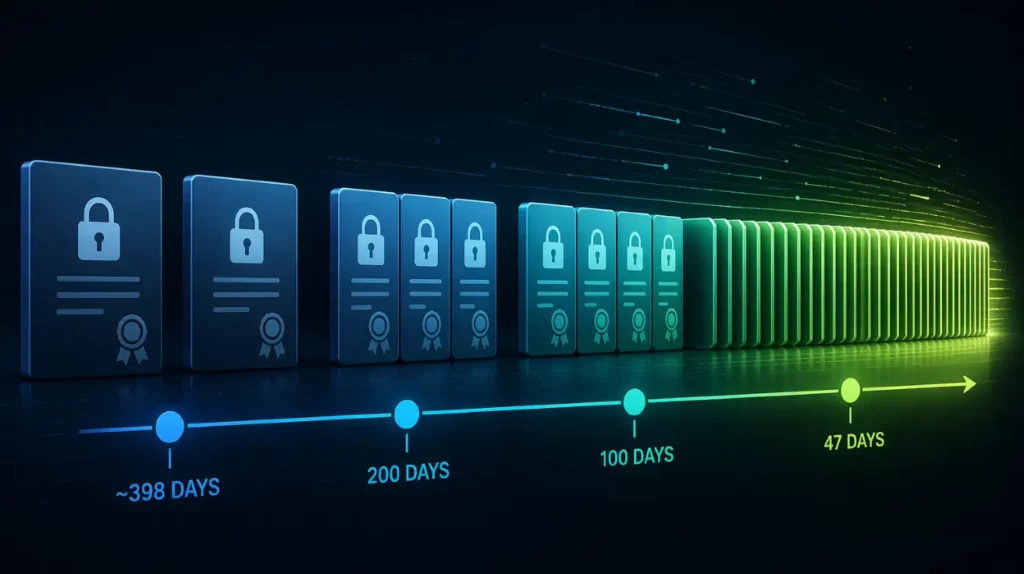
The CA/Browser Forum defined a fixed schedule that reduces the maximum validity period for SSL/TLS certificates.
- Until March 14, 2026: Maximum validity was ~398 days
- From March 15, 2026: Maximum validity is 200 days
- From March 15, 2027: Maximum validity becomes 100 days
- From March 15, 2029: Maximum validity becomes 47 days
These limits apply to all certificates issued by public Certificate Authorities (CA).
Validation Reuse Periods Are Changing Too
Validation reuse periods define how long a CA can rely on previously completed domain validation when issuing a new SSL certificate. In simple terms, validity controls how long a certificate remains active, while validation reuse controls how long proof of domain ownership stays acceptable for issuing new certificates. These are two different layers of the process.
Under the new CA/Browser Forum rules, validation reuse periods drop alongside certificate lifespans. This means CAs must recheck domain control more frequently instead of relying on older validation records. By 2029, reuse periods drop to as low as 10 days, which forces validation to happen almost every time a certificate is issued.
- From March 15, 2026: Validation reuse is limited to 200 days
- From March 15, 2027: Reduced to 100 days
- From March 15, 2029: Reduced to 10 days
You must renew certificates more often and revalidate domains more frequently.
Why SSL Certificate Lifetimes Are Getting Shorter
The industry is capping SSL validity to reflect how fast things change in modern infrastructure. Certificates no longer sit on static servers for years. Domains move between providers, configurations update, and ownership or control can shift much faster than before.
At the same time, the web relies on certificates as a source of trust. If that trust rests on outdated information, it becomes less reliable. Shorter certificate lifetimes and validation reuse periods keep certificate data closer to real-world conditions, reduce the time exposed to risk, and push certificate management toward faster, more controlled processes.
- Certificates Are a Snapshot in Time — SSL certificates capture domain ownership, infrastructure, and contact details that were accurate at issuance but can drift over time. Shorter lifetimes mean outdated information stays trusted for less time.
- Validation Data Needs to Stay Current — CAs need up-to-date domain ownership records to issue certificates accurately. Reusing old validation data increases the risk of issuing certificates based on information that’s no longer true, so more frequent checks keep the process honest.
- Shorter Lifetimes Limit Security Exposure — Any misissued certificate or compromised private key can only cause damage for as long as it remains valid. Fast renewal cycles reduce that window, limiting the fallout from incidents that are often impossible to prevent entirely.
- Manual Management Doesn’t Scale — When certificates expire every few weeks or months, manual renewal processes simply can’t keep up. Automation stops being optional — it becomes the only realistic way to manage the cycle consistently.
What Shorter SSL Validity Means in Practice
The new certificate timeframes expose weak points in how certificates are tracked, issued, and deployed across real infrastructure.
Renewals Become an Operational Load
A single certificate used to require attention once per year. Now that same certificate will require action three, six, or even ten times within the same period.
Take a typical setup:
- one certificate on the main domain
- one on the API
- one on staging
- one on internal services
That’s already 4+ certificates. Under shorter lifetimes, you’ll run 20–40 renewal events, each with issuance, validation, and deployment steps. This is where the math starts working against you.
Validation Will Demand More Attention
Here’s what a typical renewal will look like when the new rules kick in:
- The renewal kicks off expecting automatic issuance
- The CA requires fresh domain validation
- DNS or HTTP validation records need to be updated
- The deployment pipeline stalls until validation clears
Scale that across dozens of domains and multiple environments, and renewals stop being routine. They become unpredictable, and in setups built around CI/CD pipelines, automated deployments, or infrastructure-as-code, a single validation step that isn’t automated can hold everything up.
Manual Tracking Breaks Under Overlap
Spreadsheets, calendar reminders, and temporary processes become harder to maintain as renewal frequency increases.
Example:
- Certificate A expires in 60 days
- Certificate B expires in 45 days
- Certificate C expires in 30 days
Now repeat this across dozens of certificates. Reminders stack. Deadlines overlap. And, before you know it, you start reacting instead of managing. When many events compete at the same time, missing a certificate deadline is highly likely.
Certificates Start Slipping Out of View
Most teams underestimate how many certificates they actually run. A real environment often includes:
- CDN certificate (edge)
- Load balancer certificate
- Origin server certificate
- Internal service certificates
- Third-party integrations
Each one has its own lifecycle. Without discovery or inventory, you lose visibility. This leads to a common failure pattern:
- “The main site works, but API throws SSL errors”.
- “Frontend is fine, backend cert expired”.
Deployment Gaps Create False Confidence
A certificate can be issued successfully and still never reach the right place. A deployment script runs partially, the load balancer updates but the origin server doesn’t, and suddenly the experience becomes inconsistent. Some users connect without issue while others hit certificate errors. These failures are among the hardest to debug because they don’t present uniformly.
Beyond a certain scale, certificate management stops fitting into a checklist. It needs inventory to track what exists, monitoring to catch what’s expiring, automation to handle renewals, and reliable deployment to make sure certificates reach the right places.
Save 10% on SSL Certificates when ordering from SSL Dragon today!
Fast issuance, strong encryption, 99.99% browser trust, dedicated support, and 25-day money-back guarantee. Coupon code: SAVE10

Shorter Lifetimes Are Also Coming to Code Signing
Code signing certificates are moving in the same direction as SSL: shorter validity periods and stricter controls around how private keys are stored and managed.
DigiCert and GoGetSSL now issue code signing certificates for one year only, with clients either using their own hardware security module or ordering a physical token.
Sectigo follows a similar model — one year if you’re using a token, but one, two, or three-year options become available if you’re managing keys through your own HSM, such as a YubiKey.
The pattern is consistent: longer validity is tied directly to stronger key control. The stricter the storage requirements, the more flexibility a client gets on term length. It reflects the same logic driving SSL changes. Tighter lifespans and better key management reduce the window of exposure and strengthen trust in signed software overall.
How to Prepare for the Upcoming SSL Validity Changes
Shorter certificate validity requires structured processes. The right approach depends on scale and complexity.
ACME: Best for Continuous Automation
ACME (Automated Certificate Management Environment) is a standardized protocol that allows servers and applications to request, validate, issue, and renew SSL/TLS certificates automatically. Instead of relying on manual steps like CSR generation, email approvals, or file uploads, systems interact directly with a CA through API-driven workflows.
In practice, ACME certificates handle the full lifecycle. They prove domain control using HTTP or DNS challenges, retrieve the certificate, install it, and renew it before expiration without human input.
It fits best in environments where:
- infrastructure changes frequently (cloud, containers, microservices)
- deployments run through CI/CD pipelines
- multiple domains or services require continuous certificate updates
RapidSSL AutoInstall: Simplified Automation for Standard Server Setups
AutoInstall SSL simplifies certificate management on server-based environments. Instead of requiring manual uploads, configuration edits, and repeated installation steps, it integrates directly with hosting panels to handle deployment automatically.
In practice, it works within platforms like cPanel, Plesk, and similar hosting panels where certificates are managed at the server level. Once configured, it can handle issuance and renewal while ensuring certificates are correctly installed and applied without manual intervention on each cycle.
It fits best setups where:
- servers rely on control panels or managed hosting stacks
- certificate management happens at the server level rather than through custom infrastructure
- teams want to reduce repetitive setup work without rebuilding their workflow around API-driven automation.
DigiCert CertCentral TLS Manager: Best for Growing Teams
CertCentral TLS Manager is a centralized platform for managing the full lifecycle of SSL certificates across an organization. It provides you with a single interface to issue, track, renew, and replace certificates from one place.
You can monitor expiration dates, detect certificates already deployed in the infrastructure, and manage renewals. It also supports automation through APIs and ACME integrations, allowing certificates to be issued and renewed without manual intervention while still maintaining centralized control.
It fits best in environments where:
- multiple teams or systems request and manage certificates
- certificate inventory is no longer fully visible
- renewal cycles start overlapping across different services
- centralized tracking and policy control become necessary
CertCentral does not replace infrastructure-level automation like ACME. Instead, it adds a control layer on top of it.
DigiCert Trust Lifecycle Manager: Best for Enterprise Scale
Trust Lifecycle Manager extends certificate management beyond public SSL/TLS and turns it into a unified system for handling trust across an entire organization. Instead of managing certificates in isolated tools, it brings public certificates, private PKI, and internal identities into one controlled framework.
It also integrates with enterprise infrastructure such as identity systems, cloud platforms, and DevOps pipelines, so certificate operations become part of existing workflows rather than a separate process.
It fits best in environments where:
- certificate usage spans public and private systems
- multiple teams or departments manage their own certificates
- infrastructure includes cloud, on-prem, and hybrid setups
- governance, compliance, and audit requirements matter
At this scale, the challenge is not just renewal, but visibility, control, and consistency across hundreds or thousands of certificates
Final Thoughts
The era of “set it and forget it” for web security is officially over. We’re moving away from certificates that last for years and toward a world where they expire in just a few weeks.
The clock is already ticking. Companies still trying to handle these updates by hand are going to feel the heat as the deadlines pile up. On the flip side, the teams that embrace a smoother, more automated way of working will barely notice the change. Shorter lifespans are the new reality, and the only way forward is to stop reacting and start streamlining.
SSL Dragon offers automation solutions that fit every setup, from simple server environments to complex, large-scale infrastructures. Whether you need ACME protocol-based automation, streamlined deployment, or full lifecycle management, you can choose the approach that matches your needs and keep your certificates under control as renewal cycles accelerate.
Save 10% on SSL Certificates when ordering from SSL Dragon today!
Fast issuance, strong encryption, 99.99% browser trust, dedicated support, and 25-day money-back guarantee. Coupon code: SAVE10