



Every day, millions of websites, applications, and devices rely on digital certificates to prove they are who they say they are. These certificates create the padlock icon in your browser, encrypt your email, and verify that software updates aren’t tampered with.
But here’s the problem: certificates don’t last forever. They expire. They get compromised. And if you’re managing hundreds or thousands of them across your infrastructure, keeping track becomes a serious challenge.

That’s where certificate management comes in. Modern organizations can’t afford expired certificates causing outages or security gaps. Certificate validity periods are shrinking fast. They are now limited to 200 days as of 15 March 2026, will drop to 100 days from March 2027, and to just 47 days starting March 15, 2029. As certificate volumes grow, a solid certificate management strategy isn’t optional anymore—it’s essential.
Table of Contents
- What Is Certificate Management?
- Digital Certificates and How They Work
- Understanding the Certificate Lifecycle
- Certificate Authorities and PKI Architecture
- Manual vs Automated Certificate Management
- Why Effective Certificate Management Is Essential
- Use Cases and Applications
- Selecting a Certificate Management Solution
- Future Trends and Best Practices
- Take Control of Your Certificate Management
What Is Certificate Management?
Certificate management is the process of tracking, issuing, renewing, and revoking digital certificates throughout their lifecycle. It ensures secure communications by preventing expired, misused, or compromised certificates from creating vulnerabilities in systems or networks.
Think of it as lifecycle management for the credentials that keep your digital infrastructure secure. Without proper management, certificates expire unnoticed, causing website outages, broken APIs, and security vulnerabilities.
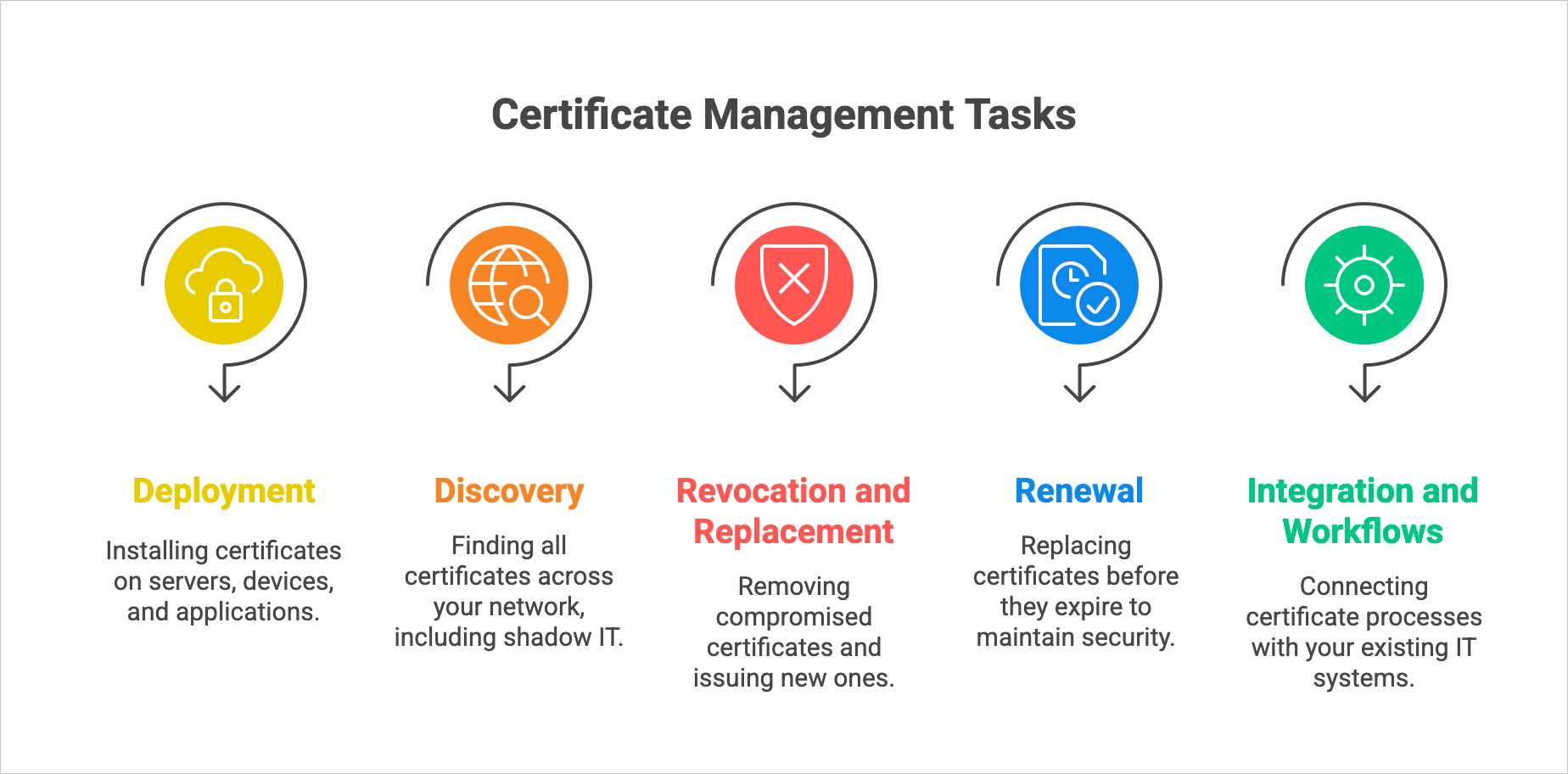
Effective certificate management rests on five core pillars:
- Deployment – Installing certificates on servers, devices, and applications
- Discovery – Finding all certificates across your network (including shadow IT)
- Revocation and replacement – Removing compromised certificates and issuing new ones
- Renewal – Replacing certificates before they expire
- Integration and workflows – Connecting certificate processes with your existing IT systems
Organizations that get these pillars right maintain continuous trust with users and avoid the costly downtime that comes with expired certificates.
Digital Certificates and How They Work
A digital certificate is essentially an electronic credential that proves identity online. More technically, it’s an X.509 certificate that binds a specific identity (like a domain name or organization) to a public key.
When you visit a website secured with HTTPS, your browser performs a TLS handshake. During this process:
- Your browser requests the website’s certificate
- The server presents its SSL/TLS certificate
- Your browser verifies the certificate is valid and issued by a trusted certificate authority
- If validation succeeds, an encrypted connection is established using the certificate’s public key
This happens in milliseconds, but it’s what keeps your data safe from eavesdroppers.
Common types of digital certificates include:
- SSL/TLS certificates – Secure websites and web applications
- S/MIME certificates – Encrypt and sign emails
- Code signing certificates – Verify software hasn’t been altered
- Email signing certificates – Authenticate sender identity
Each certificate type serves a specific purpose, but they all share the same fundamental structure and require proper lifecycle management.
Save 10% on SSL Certificates when ordering from SSL Dragon today!
Fast issuance, strong encryption, 99.99% browser trust, dedicated support, and 25-day money-back guarantee. Coupon code: SAVE10

Understanding the Certificate Lifecycle
Managing certificates means understanding each stage they go through. Here’s what the certificate lifecycle looks like in practice:
1. Discovery
Before you can manage certificates, you need to know where they are. Certificate discovery involves scanning your entire network—servers, load balancers, containers, IoT devices—to create a complete digital certificate inventory. Many organizations are shocked to find certificates they didn’t know existed (often called shadow certificates).
2. Provisioning and Creation
This stage involves certificate generation—creating a Certificate Signing Request (CSR) with the appropriate public/private key pair, then submitting it to a certificate authority for signing. You’ll need to decide on key strength, validity period, and other parameters based on your security requirements.
3. Deployment and Installation
Once you receive the signed certificate, it needs to be installed on the correct endpoints. This includes configuring web servers, load balancers, and any other systems that will use the certificate. Improper installation can cause certificate errors or security warnings.
4. Monitoring and Reporting
Active certificate monitoring and supervision track the status of all deployed certificates. A good certificate monitoring dashboard shows expiration dates, alerts you to upcoming renewals, and flags potential issues like weak encryption or certificates from untrusted sources.
5. Renewal
Certificates have limited validity periods. Certificate renewal involves obtaining a new certificate before the old one expires. With automated renewal workflows, this happens seamlessly without manual intervention or service interruption.
6. Revocation
When a private key is compromised or a certificate is no longer needed, it must be revoked immediately. The CA adds the certificate to a Certificate Revocation List (CRL), telling systems not to trust it anymore. Speed matters here—delays leave your infrastructure vulnerable to certificate breaches.
7. Retirement
Eventually, certificates reach end-of-life. Proper retirement means securely removing the certificate from all systems, archiving records for compliance purposes, and ensuring no dependencies remain that could cause future issues.
Each stage requires attention. Miss one, and you risk security gaps or service disruptions.
Certificate Authorities and PKI Architecture
Digital certificates exist within a trust framework called public key infrastructure (PKI). At the center of this framework are certificate authorities—trusted organizations that issue, validate, and revoke digital certificates. This infrastructure is closely tied to identity management, ensuring that certificates properly authenticate users, devices, and services.
The PKI hierarchy works like this:
Root CA – The top-level authority with a self-signed certificate. Root certificates are embedded in browsers and operating systems. If compromised, the entire chain of trust collapses, so root CAs are kept offline and heavily guarded.
Intermediate CA (Subordinate CA) – Issues certificates on behalf of the root CA. Using intermediate CAs provides a security buffer—if an intermediate CA is compromised, only that branch needs replacement, not the entire root.
End-entity certificates – The certificates actually deployed on servers, devices, and applications. These are what users interact with when visiting your website or connecting to your VPN.
Certificate authorities like Sectigo and others maintain this trust hierarchy. They also operate certificate repositories where you can check certificate status and download CRLs to verify certificates haven’t been revoked.
Understanding this architecture is crucial because your certificate management system needs to work within these constraints. You can’t just create valid certificates yourself—they must be issued by a trusted CA to be accepted by browsers and other systems.
Manual vs Automated Certificate Management
Many organizations start managing certificates with spreadsheets. Someone tracks expiration dates, sets calendar reminders, and manually renews certificates before they expire.
This works fine when you have five certificates. It becomes impossible with five hundred.
Manual certificate management:
- 👎 Requires constant human oversight to track expiration dates
- 👎 Costs significant time in labor hours for routine renewals
- 👎 Creates high risk of human error (missed renewals, incorrect configurations)
- 👎 Provides no visibility into shadow certificates or compliance status
- 👎 Doesn’t scale as certificate volumes grow
Automated certificate management platforms:
- 👍 Discover all certificates across your infrastructure automatically
- 👍 Send alerts well before certificates expire
- 👍 Handle automated certificate renewal without human intervention using automated certificate management tools (ACME)
- 👍 Provide centralized dashboards showing certificate inventory and status
- 👍 Integrate with existing IT systems and PKI infrastructure
The contrast is clear: automation dramatically reduces the manual effort and error rate of certificate lifecycle management. As organizations adopt more cloud services, containers, and IoT devices, the number of certificates multiplies. Without certificate lifecycle automation, you’re fighting a losing battle.
Save 10% on SSL Certificates when ordering from SSL Dragon today!
Fast issuance, strong encryption, 99.99% browser trust, dedicated support, and 25-day money-back guarantee. Coupon code: SAVE10
Why Effective Certificate Management Is Essential
Poor certificate management isn’t just an IT inconvenience—it causes real business damage.
Certificate outages shut down services. When a certificate expires on your web server, customers see scary security warnings. They leave. Revenue stops. In 2021, expired certificates caused high-profile outages at organizations like Microsoft and Google, affecting millions of users.
Security breaches happen. An expired certificate is one thing. A compromised certificate in active use is worse. Without proper certificate monitoring, attackers can exploit weak or stolen certificates to impersonate your services, intercept data, or install malware. Certificate breaches expose your organization to data theft and regulatory violations. The damage compounds when you can’t quickly revoke and replace the compromised certificate.
Reputational damage lingers. Users expect your site to be secure. Certificate errors or outages erode trust. That trust took years to build and can vanish in hours.
Compliance risks multiply. Standards like PCI DSS, HIPAA, and GDPR require proper cryptographic key management and encryption controls. Poor certificate management creates audit findings and potential fines. Organizations must demonstrate they’ve addressed known vulnerabilities in their certificate infrastructure.
Proper certificate lifecycle management reduces all these risks. It ensures your chain of digital trust remains intact, your services stay online, and your security posture stays strong.
Use Cases and Applications
Certificate management matters across virtually every part of modern IT infrastructure. Each scenario has unique requirements, but centralized management makes all of them easier.
- Websites and ecommerce sites – SSL/TLS certificates secure customer transactions and protect sensitive data. A single expired certificate can crash checkout systems and cost thousands in lost sales.
- Intranet portals – Internal applications need certificates too. Employees expect secure access to HR systems, document repositories, and collaboration tools.
- VPN access – Certificates authenticate VPN connections, ensuring only authorized users access your network. Proper management prevents access failures and security gaps.
- Point-of-sale systems – Retail POS terminals use certificates to secure payment data. Certificate problems can shut down an entire store’s ability to process transactions.
- IoT devices – Smart sensors, industrial equipment, and connected devices increasingly use certificates for authentication and encryption. Managing thousands of IoT certificates manually isn’t feasible.
- DevOps and containers – Microservices architectures create and destroy containers constantly. Certificate provisioning and certificate discovery must happen automatically to keep pace.
- Cloud and multi-cloud environments – Organizations running workloads across AWS, Azure, Google Cloud, and private data centers need unified certificate management that works across all platforms.
- Mobile devices – Smartphones and tablets use certificates for app authentication, email encryption, and enterprise access. Mobile device management systems need tight integration with your certificate management platform.
- Code signing and email signing – Developers need code signing certificates to ensure software integrity. Employees need email signing certificates for secure communications.
Each use case benefits from the same core practices: automated discovery, proactive monitoring, and streamlined renewal.
Selecting a Certificate Management Solution
Not all certificate management software is created equal. When evaluating options, focus on capabilities that actually solve your problems.
Must-have features:
- Discovery capabilities – Can it find all certificates across on-premises, cloud, and hybrid environments? Unknown certificates are security risks.
- Automated renewal – Does it integrate with your CAs to request and install renewed certificates without manual intervention?
- PKI integration – Can it work with your existing public key infrastructure, whether that’s an internal CA, PKI as a Service (PKIaaS), or external providers like Sectigo?
- User-friendly dashboards – Will your team actually use it? Complex interfaces lead to workarounds and shadow IT.
- Scalability – Does it handle your current certificate volume and future growth without performance issues?
- Compliance reporting – Can it generate audit reports showing certificate status, encryption standards, and policy compliance?
- Consider whether you need a managed PKI service, where a provider handles the CA infrastructure, or a certificate lifecycle automation platform that works with your existing CAs. Both approaches have merit depending on your technical expertise and resource availability.
SSL Dragon is an authorized reseller of DigiCert One and offers access to industry-leading certificate management solutions including DigiCert Trust Lifecycle Manager and DigiCert CertCentral TLS/SSL Manager. These platforms provide comprehensive certificate lifecycle automation, discovery, and monitoring capabilities to keep your infrastructure secure and compliant.
Future Trends and Best Practices
Certificate management is evolving quickly. Stay ahead by watching these trends:
Shorter validity periods – Certificate lifespans keep shrinking. Major browsers already enforce 398-day maximums for public SSL/TLS certificates. Proposals for 90-day or even 47-day certificates are gaining traction. Shorter validity improves security but makes certificate renewal automation critical.
Quantum-safe cryptography – Quantum computers threaten current encryption methods. Organizations are beginning to implement quantum-safe security algorithms to protect against future threats. Your certificate management strategy needs to support algorithm agility.
Zero trust architecture – Modern security frameworks based on zero trust principles require strong certificate-based authentication for every user, device, and application. This multiplies the number of certificates you need to manage.
Increased automation requirements – As certificate volumes grow and validity periods shrink, manual management becomes impossible. Certificate management platforms with full automation aren’t luxury items—they’re necessities.
Follow these best practices:
- Inventory everything – Use certificate discovery tools to maintain a complete digital certificate inventory. You can’t manage what you don’t know about.
- Enforce policies – Set standards for key length, validity periods, and approved CAs. Make compliance visible.
- Automate monitoring and renewal – Configure alerts for certificates expiring within 30-60 days. Automate renewal wherever possible.
- Regularly audit – Review your certificate inventory quarterly. Look for weak encryption, policy violations, and certificates from untrusted sources.
- Plan for incidents – Have a process to quickly revoke and replace compromised certificates. Test it before you need it.
Certificate management isn’t a one-time project. It’s an ongoing practice that protects your organization from outages and security breaches.
Take Control of Your Certificate Management
SSL Dragon makes certificate management easier with DigiCert One solutions. We provide access to DigiCert Trust Lifecycle Manager for comprehensive certificate lifecycle automation and DigiCert CertCentral TLS/SSL Manager for centralized SSL/TLS certificate management. These enterprise-grade platforms handle discovery, monitoring, automated renewal, and compliance reporting—keeping your infrastructure secure without the manual overhead.
Ready to protect your organization from certificate outages and security risks? Contact our team to discuss how DigiCert Trust Lifecycle Manager and CertCentral can fit your infrastructure needs.
Save 10% on SSL Certificates when ordering from SSL Dragon today!
Fast issuance, strong encryption, 99.99% browser trust, dedicated support, and 25-day money-back guarantee. Coupon code: SAVE10