



HTTPS is now a default expectation on the web. But while encryption has become the baseline for online security, paying for SSL certificates has not.
At SSL Dragon, we know exactly where SSL certificates are actually being bought, and want to give you a unique glimpse into the geographical distribution of paid encryption.

In our data, one country alone accounts for nearly 38% of all paid SSL purchases. The top ten countries control over 67%. HTTPS may be universal, but paid trust is highly concentrated.
Let’s take a closer look at what the global map of paid SSL really shows.
Table of Contents
- What Our Numbers Show (and What They Don’t)
- The Core Finding: Paid Trust Clusters Hard
- Clients vs Services: Two Very Different Stories
- The Countries That Look “Wrong” Are the Most Interesting
- What This Means for Teams Managing Certificates?
Methodology Note
- Data source: anonymized operational data from SSL Dragon
- Scope: paid SSL certificates only
- Metrics: active clients and active services
- Data snapshot: January 2026
- Excludes: platform-issued certificates (CDN auto-SSL, hosting bundles, Let’s Encrypt, etc.)
What Our Numbers Show (and What They Don’t)
These numbers are not about SSL usage. HTTPS is already everywhere. Most websites run on certificates issued automatically by hosting providers, CDNs, and cloud platforms. That activity doesn’t appear in our data. What it shows is something much more specific:
- Where organizations still buy certificates
- Where they still manage validation themselves
- Where certificate handling is treated as an operational task, not a platform feature
In other words, this is not adoption figures. It’s purchase behavior.
The data reflects two different dimensions:
- Active Clients – how many organizations are buying certificates
- Active Services – how many certificates are actively deployed
Together, they show both demand and operational scale.
High numbers here mean:
- Custom infrastructure
- Self-managed servers or load balancers
- Internal compliance or audit requirements
- A need for tighter control over issuance and deployment
Low numbers mean:
- Heavy use of managed hosting
- Certificates bundled into platforms
- Trust delegated to third-party infrastructure
A high ranking points to markets where companies still run their own infrastructure and actively manage trust. A low ranking usually reflects environments where that responsibility has already shifted to platforms and managed services.
The country tied to a purchase doesn’t always match where a certificate is deployed. Agencies, hosting providers, and centralized IT teams often manage certificates as an outsourced service for infrastructure they don’t directly own.
That doesn’t blur the picture. It sharpens it and shows where ownership and operational control over certificates really sit.
The Core Finding: Paid Trust Clusters Hard
When you step back and look at the distribution of paid SSL demand, one fact becomes impossible to ignore: it doesn’t spread evenly. It concentrates aggressively.
The top ten countries alone account for approximately 67% of all active paying clients.
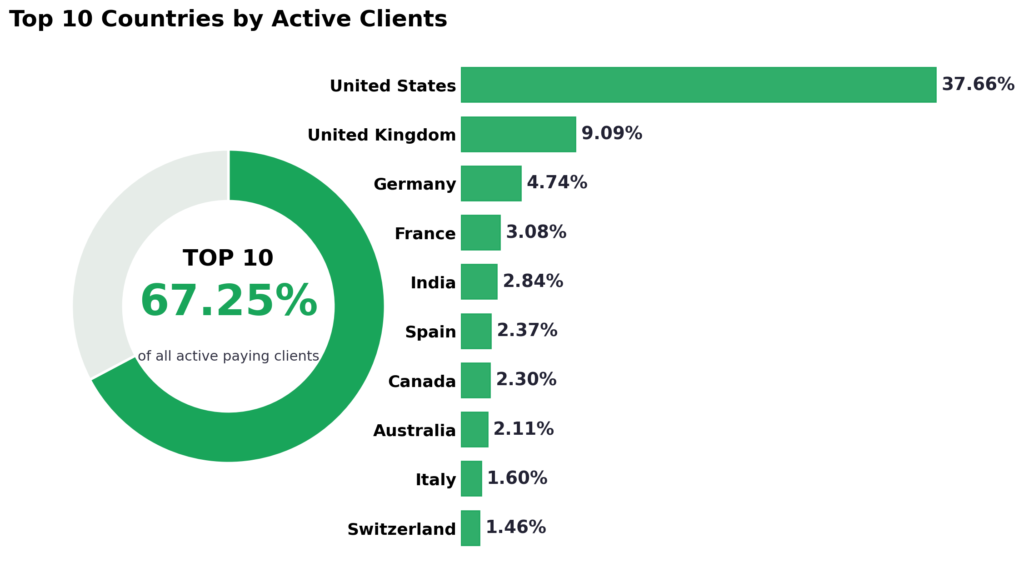
That means two-thirds of global SSL orders come from a very small slice of the world. Even more striking, the United States by itself represents nearly 38% of all paying organizations. One country carries more paid trust activity than the rest of the world combined. That’s not what a “global” market looks like.
If SSL certificates were purchased purely based on technical necessity, this distribution would be flatter. Websites and businesses exist everywhere. HTTPS is all but mandatory, but paid trust is not. It follows something much narrower: who still owns their infrastructure and who has handed it over to platforms.
Markets that dominate commercial SSL adoption tend to be places where organizations still operate their own servers, manage their own load balancers, and run internal compliance processes.
By contrast, in most regions, certificate management has shifted to platforms. Hosting providers, CDNs, SaaS products, and cloud services terminate SSL automatically. This is why the demand curve is steep. After the top few countries, paid SSL activity drops sharply.
The United States and the United Kingdom dominate because they host massive volumes of self-managed infrastructure, enterprise systems, and compliance-driven environments.
A second tier of countries follows, typically advanced economies with strong SaaS, finance, and technology sectors. After that, the curve collapses into a long tail where paid certificate ownership becomes rare.
Where Paying Customers Concentrate
When you visualize the top countries by active paying clients, three things become immediately clear:
- One market controls everything else. The United States defines the scale of the entire dataset.
- A small European core follows. The UK, Germany, France, and a handful of others form a second cluster of operational ownership.
- After the top tier, paid SSL usage drops sharply. Most countries contribute marginal volumes by comparison.
This steep drop is the signature of an operational market, not a consumer one.
In practical terms, this means:
- Certificate buying patterns do not map to the population.
- It does not map to internet usage.
- It does not map to website counts.
This is why the idea of SSL as a “global commodity” is misleading. The encryption layer may be universal, but the ownership of trust is not. That is what your numbers are actually saying.
Save 10% on SSL Certificates when ordering from SSL Dragon today!
Fast issuance, strong encryption, 99.99% browser trust, dedicated support, and 25-day money-back guarantee. Coupon code: SAVE10

Clients vs Services: Two Very Different Stories
So far, we’ve looked at where certificates are being purchased. But buying a certificate is only the beginning of the story.
What really matters is what happens after: how many certificates are deployed, maintained, rotated, and kept alive in production.
That’s where the second lens comes in: Active Clients vs Active Services.
They measure different things:
- Active Clients tell us how many organizations are buying certificates.
- Active Services reveal how many certificates are actually in operation.
One shows demand. The other — operational load. And those two don’t always grow at the same rate.
In some countries, many organizations buy one or two certificates each. In others, a small number of companies run dozens, hundreds, or even thousands of active certificates.
From an operational perspective, those markets behave completely differently. One is about the volume of buyers. The other is about the scale of infrastructure.
This is where certificate management becomes a systems problem.
High Active Clients with low Active Services usually means:
- Many small buyers
- Simpler environments
- Limited infrastructure complexity
Low Active Clients with high Active Services usually means:
- Fewer organizations
- Heavy automation
- Centralized infrastructure
- Massive renewal pressure
That second group is where certificate operations become fragile:
- Renewal failures multiply
- Deployment errors cascade
- Monitoring becomes critical
- Small mistakes have a wide impact.
When you look at active services, you’re no longer mapping where certificates are bought, but where trust infrastructure is run at scale.
Where Certificate Operations Scale Up
This chart shows the top countries by Active Services. In other words: where the largest certificate workloads actually live.
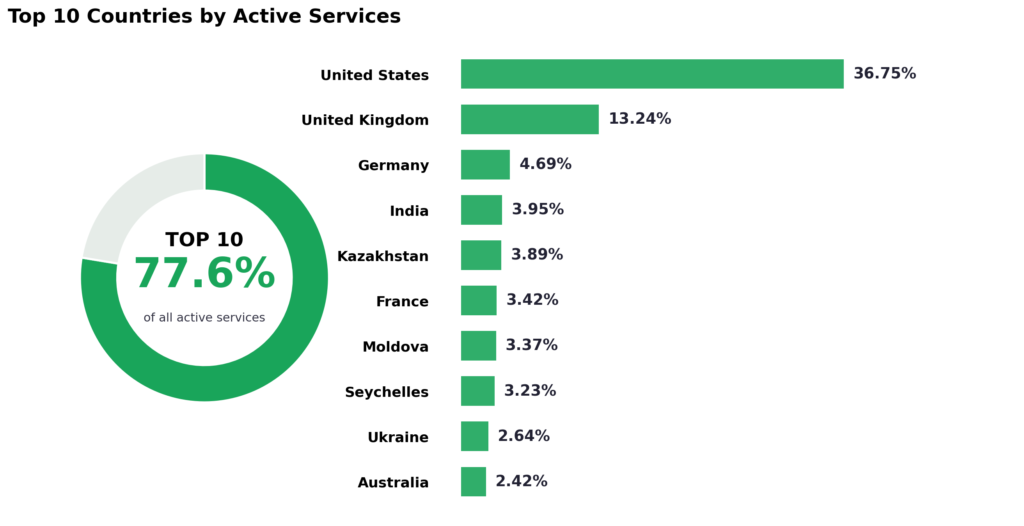
This is not a mirror of the client chart. Some countries that rank high in buyers drop down here.
Others jump upward because a smaller number of organizations operate far more certificates.
That difference matters because it changes where SSL automation risk accumulates and outages become systemic instead of isolated. This is the operational heart of the SSL ecosystem.
- Some markets buy certificates broadly, but operate them lightly.
- Others buy fewer certificates but run them at a massive scale.
- Active Services reveal infrastructure density, not market size.
This is where automation stops being convenient and becomes mission-critical.
This shift is being accelerated by shorter certificate validity periods. The CA/Browser Forum has set a clear timeline: 200 days from March 15, 2026, 100 days from March 15, 2027, and 47 days starting March 15, 2029.
As renewal cycles tighten, certificate management is increasingly handled through ACME-based automation, where domain validation, issuance, and renewal are completed automatically, especially in environments managing large numbers of certificates.
The Countries That Look “Wrong” Are the Most Interesting
When you first scan the rankings, some countries are in the right place. The US, UK, Germany, and France are large economies with huge infrastructure footprints and enterprise environments. No surprise there.
But then a few names appear that feel out of place: Kazakhstan, Moldova, Seychelles, and Ukraine.
On paper, these are not markets you would expect to sit high in certificate activity, especially not on the active services side. And that is exactly why they matter. They expose how certificate operations actually organize themselves once they move from transactions to infrastructure.
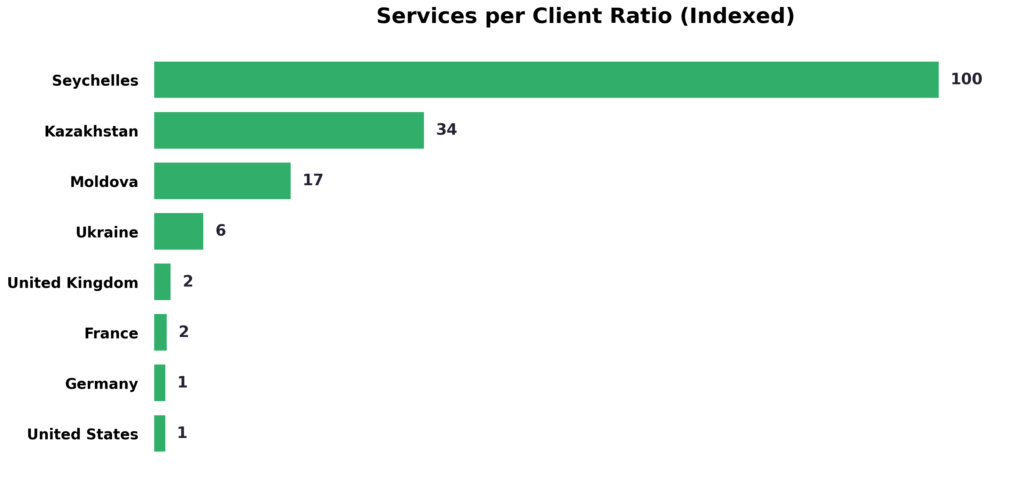
Take Kazakhstan. It shows a very small number of active clients but an extremely high number of active services. That ratio signals aggregation. A handful of organizations are operating certificates at scale for:
- Hosting platforms
- Service providers
- Regional infrastructure hubs
- Managed security or IT operations
This is what centralized certificate ownership looks like. Not thousands of buyers, but a few operators carrying massive workloads.
Moldova shows the same structure even more clearly. Very few clients, very high service volume. Certificates are being managed as an infrastructure layer, not as individual purchases. One organization may represent dozens or hundreds of downstream systems.
Seychelles looks even stranger at first glance. Extremely high active services with almost no active clients. But this pattern emerges when certificates are registered through centralized legal or billing entities, while the infrastructure itself is global. It points to:
- Reseller aggregation
- International hosting providers
- Corporate structures optimized around taxation or regulation
- Centralized certificate ownership for distributed platforms
Ukraine shows a different variant of the same pattern. Higher service density than client count, suggesting that a smaller number of technical operators run large, certificate-heavy infrastructures. This is common in environments with:
- Strong hosting ecosystems
- Outsourced infrastructure management
- Regional SaaS and platform providers
- Cost-efficient centralized operations
These countries reveal where certificate volume no longer comes from buyers, but from operators running trust at scale.
What This Means for Teams Managing Certificates?
Here are 5 takeaways from inside the machine:
- Your real SSL risk is defined by structure: The danger zone is not “how many certificates you have,” but how centralized they are. If a small number of systems or teams control a large share of your certificates, every failure has a multiplied impact. That’s where outages become systemic instead of local.
- Certificate operations reveal hidden single points of failure: Countries like Kazakhstan or Moldova don’t stand out because of market size, but due to control collapsing into a few operators. The same thing happens inside companies. If one team, one platform, or one automation pipeline carries most certificates, you have concentration risk.
- Buying certificates is easy. Running them safely is the real workload: The charts show that purchase volume and operational pressure are not the same thing.
A team with 50 certificates can have less complexity than a team with 5 if those 5 sit on load balancers, gateways, and shared infrastructure. - Automation without visibility is a liability at scale: Once active services climb, renewal stops being a calendar problem. If you cannot answer in seconds which systems actually reloaded the new cert, you are flying blind.
- Certificate ownership always migrates upward: The data shows a one-way pattern: from companies to platforms to infrastructure operators. Once trust becomes centralized, it almost never decentralizes again.The only choice left is whether you control that layer or depend on someone who does. That decision defines how much of your trust stack you truly own.
Paid SSL demand ultimately reflects who still owns and operates their trust layer. In some environments, that responsibility remains in-house; in others, it has already moved to platforms and infrastructure providers. Understanding where your organization sits on that line is what determines how much control, visibility, and resilience you truly have over your security.
Curious what your trust layer actually looks like in practice? Use our free SSL Checker to inspect any domain and see which certificates are running in production.
Save 10% on SSL Certificates when ordering from SSL Dragon today!
Fast issuance, strong encryption, 99.99% browser trust, dedicated support, and 25-day money-back guarantee. Coupon code: SAVE10