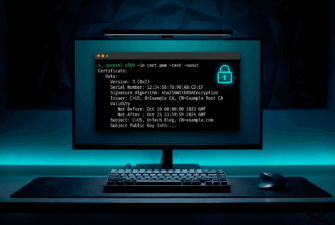



SSL certificates are often treated as a set-and-forget layer of infrastructure. Once installed, browsers stay quiet, and encryption fades into the background.
From a support perspective, reality looks very different. Behind routine installations sits a steady flow of tickets where certificates are technically valid, correctly deployed, and still failing in ways that aren’t immediately visible.
In many of these cases, everything checks out. Until one legacy Android device, running a trust store that hasn’t been updated since what feels like the Jurassic Park era, decides the certificate doesn’t belong.
To understand what actually makes SSL issues difficult to diagnose, we spoke with members of our support team who deal with these incidents firsthand.
What emerges from these conversations is a clearer picture of SSL support as layered diagnostics across platforms, ecosystems, and assumptions — where even a secure certificate can still fail under the right conditions.
Table of Contents
- The SSL Issues That Are Hardest to Spot
- The Errors That Pretend to Be Simple
- The Mistakes Clients Repeat Most Often
- The SSL Tickets That Truly Tested Our Team
- The Mindset You Need to Work in SSL Support
- The Qualities That Help You Solve Complex SSL Issues
- What Outsiders Underestimate About SSL Support
The SSL Issues That Are Hardest to Spot
Some SSL problems introduce themselves politely. They show up with clear errors, obvious misconfigurations, and predictable fixes. And then there are the other ones — the issues that behave perfectly in every environment except the one the customer actually uses. These are the tickets that make support stare at the screen and think, “Here we go again.”
The Selective Failures No SSL Checker Warns You About
Paloma, a member of our SSL support team, often deals with these failures triggered by legacy devices:
“The certificate may be technically valid and correctly installed, yet still fail due to trust differences on certain platforms.”
In practice, that means everything works on modern browsers, but one stubborn Android gadget decides the certificate “doesn’t belong here.”
These cases are particularly fun because every SSL checker cheerfully reports that everything is perfect. Meanwhile, a real human on the other side of the world is staring at a giant red warning.
When the Real Problem Isn’t the Certificate at All
For Dragoș, another support specialist, the difficulty sometimes begins before he even gets to the cert itself. Customers occasionally open a ticket without an error message or knowing the platform they’re using. To make things worse, they don’t even pass domain validation.
Debugging becomes detective work. It’s less “fix the certificate” and more “reconstruct the missing half of the crime scene.”
When the Entire Ecosystem Shifts
Iuliana, working on the SSL operations side, remembers the early days, when even routine issues felt complex, especially industry-wide moments like the Sectigo root change:
“At the beginning, all the tickets were hard. For example, the Sectigo root changes.”
Those large ecosystem shifts make SSL feel less like a protocol and more like an earthquake everyone must adjust to at once.
Across all three perspectives, one idea repeats:
The real challenge isn’t the certificate itself, but the world it has to survive in.
These tickets test patience, pattern recognition, and emotional stability. They remind us that SSL doesn’t just depend on one certificate, but on every device, trust store, browser, server, and validation rule agreeing on the same thing at the same time. And that’s a lot to ask on a Monday.
The Errors That Pretend to Be Simple
Some SSL issues walk in the door looking harmless. A “certificate not secure” warning. A customer message that starts with, “Hey, something’s off — should be a quick fix.”
Our support knows that tone well. It’s the sound of a problem warming up before it reveals its real shape.
When the Error Message Lies by Omission
A browser warning might sound specific, but behind it is an entire list of possibilities.
Dragoș puts it bluntly:
“Any technical SSL error can come from many, many things. There is no single setting that magically solves everything.”
That sentence should be printed on a poster in every server room. Because underneath a generic warning, you might find:
- a misconfigured web server
- a wrong intermediate chain
- a missing private key
- a private key mismatch
- an outdated operating system
- misconfigured system settings
- even a network issue masquerading as SSL
One message. Seven entirely different realities.
Why “Certificate Not Secure” Is Not a Diagnosis
Paloma sees this mistake often:
“Issues like ‘certificate not secure’ look simple but usually hide deeper causes.”
Customers assume the warning is the cause. Support knows the warning is just a flare.
The browser isn’t telling you what’s wrong; it just gave up trying to figure it out. The real investigation begins after that.
How the Illusion of Simplicity Slows Everything Down
Most users expect this kind of problem to be fixed instantly, because the warning looks the same regardless of the actual issue.
A broken chain and a missing private key both display nearly identical browser messages — even though one takes two minutes to fix and the other requires generating a new certificate entirely.
Our team has to peel back each layer until the actual culprit shows itself. And sometimes, it’s not SSL at all, but the environment silently sabotaging the connection.
If an SSL error looks easy, it usually means it hasn’t told you the truth yet.
The Mistakes Clients Repeat Most Often
If there’s one mistake the support team sees more than any other, it’s people losing their private keys and then assuming someone else has a backup.
Dragoș doesn’t sugarcoat it:
“By far, forgetting their private keys.”
Paloma adds context that turns the issue from harmless to critical:
“Many clients assume the private key can be regenerated or provided by the Certificate Authority or us, when in reality it is created locally during CSR generation and never shared. This misunderstanding leads to failed installations, reissues, or compatibility issues.”
Reissues and Renewals: The Other Recurring Headache
Not every recurring issue is technical. Iuliana sees clients repeatedly confuse reissuing with renewing, treating them as interchangeable, or attempting one when they need the other.
“Usually it’s about reissue or renewal”, she adds.
For support, these misunderstandings create loops: customers request fixes that aren’t tied to the actual lifecycle step they need.
Renewal season becomes its own category of déjà vu.
Domain Validation Still Trips People Up
Dragoș mentions another consistent stumbling block — DV.
Many clients don’t understand why the CA refuses validation or which format they must use to complete it.
And without that step, nothing moves forward. It’s a small detail for the client, but a hard blocker for support. In SSL, the smallest overlooked detail is usually the thing holding up the entire deployment.
The SSL Tickets That Truly Tested Our Team
Some tickets look tricky until you uncover the punchline: the setup was impossible from the start.
Dragoș remembers one case exactly like that:
“The customer’s domain was a local one, which he couldn’t pass DV for by default.”
Everything about the issue behaved like a normal validation failure, until he realized nothing was wrong. The domain wasn’t public, and no CA on earth could validate it.
The solution was to guide the customer toward a self-signed certificate instead. A simple ending, but a wonderfully chaotic beginning.
When a Certificate Fails on Just One Device
Some tricky tickets don’t announce themselves with chaos. They do the opposite. Everything works everywhere except on one device the customer actually cares about.
Paloma remembers a pattern from her early support days:
“Certificates that work in one environment but fail in another — for example, working on desktop but not on older mobile systems.”
Those cases become puzzles, because every modern browser shows a clean chain, SSL checkers give a thumbs-up, and nothing looks wrong on the server. The failure hides inside a single outdated trust store that has no place in the modern setups.
It’s the kind of ticket that feels simple until the hours start stacking.
Save 10% on SSL Certificates when ordering from SSL Dragon today!
Fast issuance, strong encryption, 99.99% browser trust, dedicated support, and 25-day money-back guarantee. Coupon code: SAVE10

The Mindset You Need to Work in SSL Support
SSL support isn’t a job where you follow a rigid script. Every ticket arrives with its own mix of missing information, unexpected behavior, and assumptions you have to untangle.
The mindset required isn’t just technical but a blend of patience, curiosity, and the willingness to learn something new.
Patience: The First Mandatory Skill
SSL certificates don’t always break dramatically. Sometimes they “fix themselves” after the customer realizes the mistake, the CA completes validation, or a configuration finally propagates.
Dragoș sees this constantly:
“Most of the time, it’s just patience. A good portion of tickets solve themselves as the time passes.”
Patience isn’t just emotional regulation — it’s a practical tool. Rushing the investigation often hides the problem in plain sight.
Learning Fast in a Moving Landscape
The SSL ecosystem isn’t static. CAs change roots, platforms update trust stores, and server environments behave differently across versions. Newcomers quickly discover there’s always one more detail to understand.
Paloma puts it clearly:
“SSL support requires intelligence, the ability to learn quickly, and dedication.”
You don’t memorize SSL. You learn how to survive the constant variations of it. That adaptability becomes more valuable than any single piece of knowledge.
Staying Positive When the Ticket Isn’t
Some cases drag on because every small step leading up to the certificate went off-script. That’s where outlook matters.
Iuliana highlights this directly:
“A positive mindset — to be positive and find solutions in challenging situations.”
Not every ticket feels solvable at first glance. Some require stepping back, resetting the approach, and refusing to let frustration guide the investigation.
SSL support isn’t a battlefield, but some days, perspective keeps the team moving through the noise.
The Qualities That Help You Solve Complex SSL Issues
Some SSL cases bend easily. Others behave as if they woke up determined to test your character. There’s a certain temperament that separates an expert who gets through these tickets… from a newbie who gets swallowed by them.
Curiosity: The Engine Behind Good Troubleshooting
Complex SSL tickets rarely hand you the answer directly. You find it by asking one more question — and then another.
Paloma sees curiosity as the cornerstone of real debugging:
“Curiosity and patience. Many times, the answer is not immediately visible.”
It’s the instinct to inspect the one configuration file everyone swears was “definitely correct,” or to test the environment no one thought could be the culprit.
Curiosity guarantees you won’t stop at the wrong assumption.
Pattern Recognition: Building Mental Templates
For Dragos, the biggest difference between beginners and experienced support agents is spotting the SSL patterns.
“The ability to learn something from every new problem helps me form mental templates.”
Every oddball ticket leaves behind a clue for the next one. Over time, the brain becomes a library of “I’ve seen this before” moments. And suddenly the complex becomes familiar.
Team Alignment: The Secret Ingredient People Forget
Teamwork is the quality that doesn’t show up on job descriptions but in every real support room.
Paloma appreciates its power:
“Being aligned and helping each other makes a huge difference.”
Some tickets are puzzles. Others are mazes. The difference is whether someone else on the team already knows where the dead ends are.
The best SSL troubleshooting happens in a team chat where people say, in unison: “Hold on, I’ve seen this before.”
What Outsiders Underestimate About SSL Support
From the outside, SSL support looks simple. But the team sees a very different reality: one where timelines depend on CAs, trust stores don’t update uniformly, and even small validation steps can stall a deployment completely.
The Parts of SSL No One Controls
Many customers assume support can fix everything instantly.
Paloma knows that’s rarely the case:
“Some steps depend on external factors, such as Certificate Authority responses or validation processes, which are outside our control.”
When a CA needs additional checks, or when validation emails don’t arrive, support isn’t “waiting”. They’re navigating around variables the customer never sees.
The Myth That SSL Is “Easy”
Iuliana points out another misconception:
“People think SSL certificates are easy to maintain.”
To someone who never touched a private key or a chain file, SSL seems like a toggle you switch on. But under the surface, it’s dozens of moving parts — servers, browsers, devices, CAs, trust stores, validation rules — all needing to agree on the same thing at the same time.
When one of those pieces drifts even slightly, support feels the impact immediately, long before the customer understands what changed.
Conclusion: What These Insights Really Show
SSL support isn’t just about replacing certificates or fixing obvious errors. Most of the real work happens in the edge cases — the outdated device, the missing key, the one server that behaves like it woke up on the wrong side of the rack. Our team’s answers make it clear: SSL failures rarely come from the certificate itself. They emerge from the ecosystem wrapped around it.
If you ever find yourself dealing with an SSL issue that doesn’t behave the way the documentation says it should, the tools we build and the people behind them are here for exactly that reason.
Save 10% on SSL Certificates when ordering from SSL Dragon today!
Fast issuance, strong encryption, 99.99% browser trust, dedicated support, and 25-day money-back guarantee. Coupon code: SAVE10