


Certificate automation is a solved problem. The tools exist, the CAs support them, and most IT teams understand the risk of going manual. Yet 38% of organizations still manage certificates with spreadsheets, and 70% admit they don’t have the staff to keep up.

The gap between what’s available and what’s adopted isn’t a technical story. It’s a business one. Companies are still pricing SSL like a line item on an invoice and ignoring the operational cost of doing it badly.
So why are organizations still doing this the hard way?
Table of Contents
- The Adoption Gap Is Real
- The Certificate Looks Cheap. The Outage Does Not
- Incidents Expose the Real Cost
- The Commodity Trap: How Free SSL Obscured Operational Risk
- Why the Math Wins: The Breaking Point of Manual PKI
- What Actually Forces the Switch to Automation
- Final Takeaway: Automation Is Now a Business Decision
The Adoption Gap Is Real
The root of the problem is a mismatch between certificate growth and certificate control.
According to Keyfactor’s PKI and Digital Trust Report, the sheer volume of certificates is skyrocketing, while the infrastructure supporting them is fracturing:
- 91% of organizations are deploying more certificates than ever before.
- Over 70% admit they lack the staff and resources to manage PKI effectively.
Yet the tools used to handle this explosion remain fragmented:
- 38% still rely on spreadsheets or manual, homegrown workarounds.
- 30% use basic, disconnected tools provided by individual certificate vendors.
- Only 32% use a dedicated certificate lifecycle management platform.
This isn’t a minor operational wrinkle. Volume is surging, but management remains stuck in an uneven, reactive loop.
The numbers also explain why automation adoption is slower than the industry expects. Many businesses are not starting from a clean, centralized certificate environment. They’re continuing with scattered records, mixed vendor tools, old renewal habits, and internal workarounds that were never designed to scale.
Adoption stalls when a company treats certificate management as background admin work until it suddenly becomes a service problem.
The Certificate Looks Cheap. The Outage Does Not.
Many businesses still place SSL certificates in the wrong mental category.
A certificate looks like a small purchase. It has a price, a renewal date, and a familiar job: keep a website trusted by browsers and prevent warnings from appearing at the worst possible moment.
Automation does not always fail because it’s technically difficult. In many systems, especially where commercial CAs and modern platforms already support automated issuance, the setup can be straightforward. The hesitation usually comes earlier, at the business level. The certificate feels cheap. The risk around it does not.
DigiCert’s 2025 Trust Pulse survey coverage shows why that distinction matters:
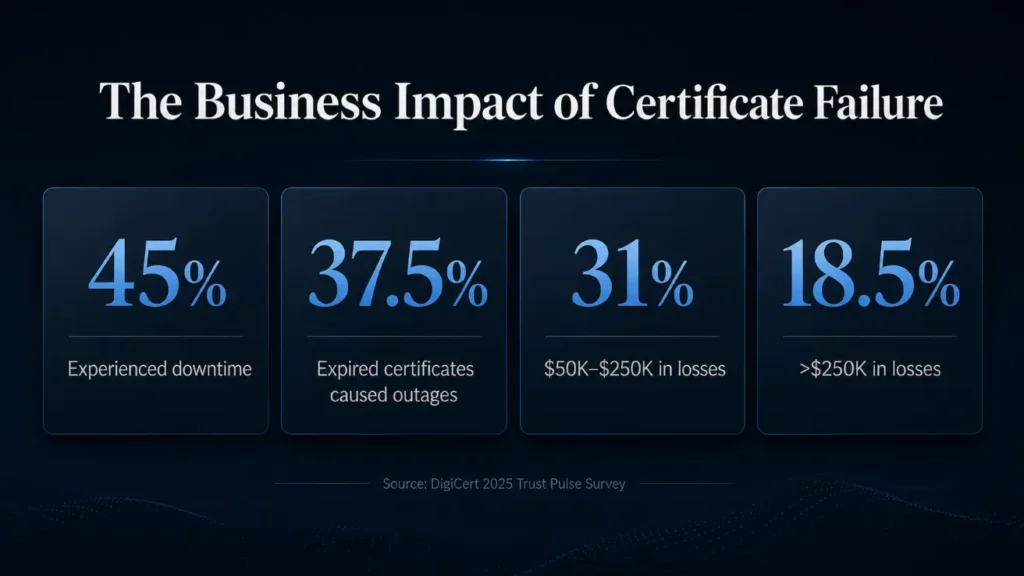
- 45% of respondents experienced service downtime from certificate-related incidents in the previous year.
- 37.5% said outages were caused by expired certificates.
The financial impact was just as sharp:
- 31% reported losses between $50,000 and $250,000.
- 18.5% reported losses above $250,000 due to certificate issues.
These numbers fundamentally change the conversation. The price of the certificate is a false benchmark. The true metric is the crushing cost of disruption when a critical, certificate-dependent service goes dark.
This is why we must look past the line-item invoice. The real value isn’t the certificate itself. It’s the process behind it. If issuance, renewal, validation, deployment, monitoring, and recovery don’t work together, the certificate is just a countdown to the next outage.
Treating SSL as a minor recurring expense guarantees that automation stays on the back burner. Mature teams treat certificates as part of the infrastructure that keeps services running. That changes how the decision gets made.
Incidents Expose the Real Cost
Certificate failures rarely stay technical for long. Once a certificate-dependent service goes down, the problem spreads fast: engineering investigates, support handles complaints, security checks what failed, and management wants to know why something so small created such a visible disruption.
KyeFactor’s PKI and Digital Trust Report report also found that organizations experienced an average of three certificate-related incidents in the previous 24 months, including outages, failed audits, and security breaches. It also found that certificate outages took an average of 2.6 hours to identify and 2.7 hours to remediate, with eight staff members involved in the response.
This resource drain clarifies the commercial argument for automation. The true liability is never the price of the certificate or the time allocated for routine renewals. It’s the cost of extended downtime, the internal chaos of emergency troubleshooting, and the erosion of user trust while teams work backward to pinpoint a single expired asset.
A certificate failure takes something nobody was watching and puts it on the status page. Automation adoption should not be measured against the effort required to implement it, but against the volume of preventable disruption a business is willing to tolerate.
The Commodity Trap: How Free SSL Obscured Operational Risk
Free SSL certificates normalized encryption across the web. However, while this move secured public browsing, it also distorted how enterprise buyers evaluate the true cost of digital trust.
Let’s Encrypt established a baseline of automated, zero-cost domain validation, while content delivery networks seamlessly bundled basic certificates into standard hosting packages. The strategy worked: Google’s HTTPS Transparency Report shows unencrypted traffic at only 0.5% on desktop and mobile. Universal encryption is no longer a feature you pay for. It’s the default.
But the rush toward free encryption left a gap in how enterprises think about the work around certificates.
Save 10% on SSL Certificates when ordering from SSL Dragon today!
Fast issuance, strong encryption, 99.99% browser trust, dedicated support, and 25-day money-back guarantee. Coupon code: SAVE10

Here’s why the “free SSL” mindset holds back automation where it matters most:
- Free and bundled tools work best for common public TLS use cases – Bundled certificates work well for most sites, but they do not automatically solve the broader mix of client portals, internal APIs, proprietary tools, secure mail, signing workflows, and multi-cloud environments that modern enterprises rely on.
- Buyers are matching the wrong price tags – Because basic encryption is now free, decision-makers often expect certificate management to feel free too. They mistake a cheap certificate for a cheap operation.
- Isolated automation can leave teams unaware of the big picture – Free ACME clients can work well, but when dozens of scripts run across different servers without centralized tracking, alerts, or reporting, the business may not see failures until a certificate-dependent service breaks.
Why the Math Wins: The Breaking Point of Manual PKI
Once certificate use spreads beyond public websites, the problem shifts from awareness to capacity.
CyberArk/Ponemon research shows a serious resource mismatch inside the typical organization:
- 114,000 digital certificates to manage.
- Four full-time employees dedicated to the task.
- Only 42% of companies feel they have enough in-house expertise to handle the workload.
- 55% actively struggle to keep pace with the growing volume of keys and certificates.
This imbalance explains why automation can lag even when the need is obvious.
A small team isn’t just updating certificates. They’re juggling internal policy changes, platform differences, vendor requirements, compliance audits, security reviews, and sudden requests from development teams that only remember certificates when a deployment fails.
At this scale, manual management fails because the work volume has outgrown the staffing model.
These figures form the strongest business case for automation. The goal isn’t to replace human judgment. It’s to strip away repetitive administrative work from a buried team so they can focus on higher-value security decisions.
At SSL Dragon, we see this as the practical core of automation. The true value is never just another cert added to a cart. It’s a cleaner operating layer around certificate management: fewer repetitive renewals, earlier failure signals, clearer support paths, and less pressure on small teams already facing machine-scale demands.
A company cannot expect four people to manually supervise a machine-scale problem forever. Eventually, the math wins.
Shorter SSL Validity Raises the Stakes
The CA/Browser Forum’s SC-081v3 schedule adds pressure: public TLS certificate validity is being reduced in phases toward 47 days, while SAN/domain/IP validation reuse is set to fall from 398 days to 10 days.
But shorter validity does not explain why automation adoption is still low. It only makes the delay harder to defend.
Certificate incidents existed before the new schedule. The coming deadlines simply compress the space businesses have to keep treating certificate management as background admin work.
What Actually Forces the Switch to Automation
Certificate automation usually moves from a background idea to an approved budget item when the old manual approach creates a problem management can no longer justify. The issue stops being a minor technical task and turns into customer complaints, internal escalation, or a public incident.
When a Failure Halts Daily Work
The real risk is that certificates do not need to sit on a primary checkout page to disrupt a business. They often sit behind authentication systems, collaboration tools, internal APIs, admin portals, and the quiet infrastructure people rely on every day without thinking.
Microsoft Teams offered a clear example. In 2020, an expired authentication certificate prevented users from accessing the platform. The technical fix was simple in principle: apply a valid certificate. The actual impact was much larger because Teams sits at the center of daily workplace communication.
Once a service goes offline, no one cares that the root cause was a small certificate file.
When the Problem Spreads Beyond Your Servers
Certificate issues can also surface deep inside vendor software or third-party infrastructure.
The 2018 O2 outage showed how wide the blast radius can become. A software issue tied to an expired certificate in Ericsson equipment left more than 30 million people in the UK unable to use mobile data. The disruption also affected services that depended on O2’s network, including London’s live bus tracking systems.
This was not a standard website renewal issue. That is exactly why it matters. Certificate-dependent code can live in places business leaders rarely look. The certificate remains invisible until the failure becomes public.
Moving From Reaction to Strategy
The goal of automation isn’t to follow what other teams are doing. It’s to remove the random failure points manual work leaves behind: one person’s memory, scattered portal logins, missed renewal emails, unclear vendor responsibility, or rushed last-minute updates.
Different assets carry different levels of risk. A basic promotional site, a customer login portal, an API, an S/MIME certificate, and a code-signing workflow do not all need the same renewal strategy.
A practical starting point is to identify where expiration would hurt most:
- Customer-facing portals and websites
- Login, payment, and checkout flows
- APIs used by clients or partners
- Email security and identity systems
- Code-signing and software-release pipelines
- Document-signing workflows
- Vendor-managed software with hidden renewal paths
Once those areas are clear, the decision becomes sharper: which workflows should be automated first, which need central monitoring, and which should never depend on a forgotten inbox or last-minute manual renewal again.
Many companies delay automation because certificate management still looks like routine paperwork. The switch happens when something breaks and proves it isn’t.
The smarter move is to fix the process before an outage forces the decision.
Final Takeaway: Automation Is Now a Business Decision
We are no longer waiting for the industry to invent better certificate automation tools. The technology is already here, stable, and widely available. The actual barrier is how businesses evaluate the risk: they are still measuring the cheap price of the certificate itself rather than the massive financial damage caused when a trusted service suddenly stops working.
This is where SSL Dragon comes in. We help organizations map out the right path across all types of digital certificates. Our focus is helping you transition to clean, predictable SSL management so that renewals stop behaving like last-minute corporate emergencies.
If your current process still relies on manual tracking, hunting for passwords across scattered vendor portals, or hoping someone catches a notification in a flooded inbox, it’s time to change the approach.
Take a look at SSL Dragon’s ACME SSL Certificates and management tools to make your renewals simple, steady, and completely under your control.
Save 10% on SSL Certificates when ordering from SSL Dragon today!
Fast issuance, strong encryption, 99.99% browser trust, dedicated support, and 25-day money-back guarantee. Coupon code: SAVE10