



At SSL Dragon, we work with SSL certificates across a wide range of environments, from simple single-domain sites to modern stacks where TLS is deliberately spread across multiple layers. Over time, that range makes one thing clear: TLS itself is stable, but the way it’s understood hasn’t kept pace with its evolution.

Today, HTTPS commonly passes through CDNs, load balancers, and ingress controllers before reaching an application, with different certificates used for different purposes. This isn’t unusual. It’s the natural result of how modern infrastructure is built.
The friction comes from assumptions that no longer hold: a single termination point, one “service certificate,” or clean environment boundaries, even as trust is distributed across layers and owners. The sections that follow map how TLS operates in modern stacks, where understanding falls behind as certificates multiply, and the mental-model failures that result.
Table of Contents
- The First Wrong Question Teams Ask About TLS
- Why No Single Certificate Can Answer “Is TLS Okay?”
- Mapping the Certificate Landscape
- The Four Mental Model Failures That Follow
- Living With Multiple Certificates: What Has to Change
The First Wrong Question Teams Ask About TLS
From SSL Dragon’s side, TLS discussions tend to break down in a very predictable way — and it happens early.
Someone asks a simple question: “Is the certificate okay?”
On the surface, that sounds reasonable, but in practice, it’s often the wrong question.
In modern systems, there are several certificates in play, each answering a different question. One tells the browser whether the site is trusted.
Another signals a load balancer what it’s allowed to serve. And there’s the one that exists purely to move traffic between internal systems. So, where’s the catch? All of them can be valid at the same time.
What we see repeatedly is people talking past each other without realizing it. Everyone is convinced they’re discussing the certificate, when in fact they’re each thinking about a different one. Nothing is broken or expired. Yet the conversation goes in circles.
That’s the mental break multi-certificate environments introduce. Not confusion, but false agreement.
The old shortcut — “check the certificate, and you’ll know what’s wrong” — no longer works once trust is split across layers. The moment that shortcut fails, decisions slow down.
Ownership feels fuzzy. Risk becomes harder to localize, even though the systems themselves are behaving exactly as expected. This is why TLS feels harder today without actually being weaker.
Why No Single Certificate Can Answer “Is TLS Okay?”
Across the environments we interact with daily, a single service commonly involves three or more certificates, each enforcing trust at a different layer:
- Edge / CDN certificate: Presented to browsers. Its only job is public trust: hostname, chain, and compatibility.
- Load balancer certificate: Attached directly to an HTTPS listener. It controls whether the platform is allowed to terminate TLS for that domain. Most major cloud load balancers explicitly support multiple certificates on a single listener via SNI — this is not an edge case.
- Ingress or routing certificate: In Kubernetes-based setups, TLS is handled at the traffic entry point before it reaches the application.
- Internal certificates: Used purely for encrypted traffic between services, APIs, or backends. End users never see them, but they still matter for trust inside the system.
All of these certificates can be valid, trusted, correctly deployed at the same time. And that’s precisely the part people underestimate.
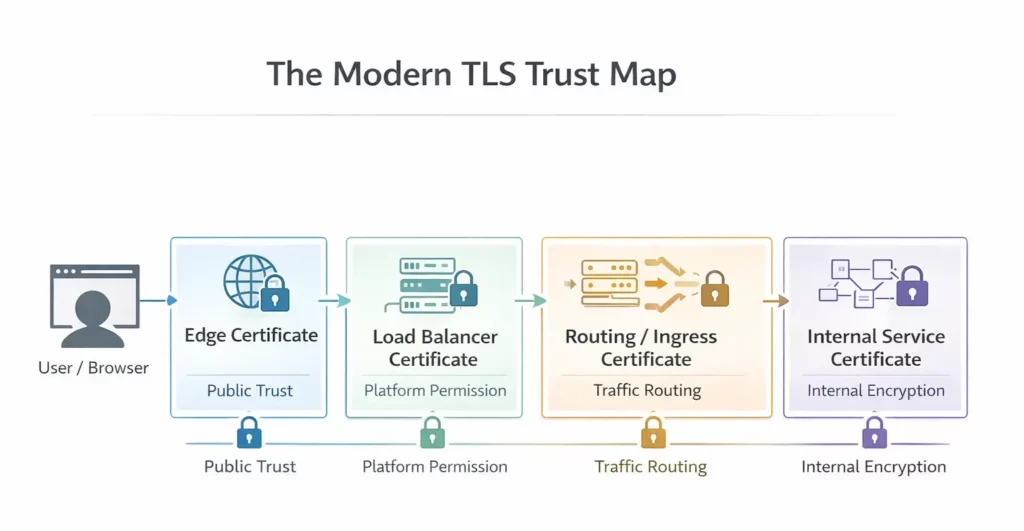
Note: Not every environment uses every hop. Some stacks terminate TLS at one point only, and some pass it through. The point is that these termination points are common — and they change what “the certificate” even refers to.
Why This Stops Being Intuitive as Systems Grow
The TLS ecosystem now operates at an industrial scale. Let’s Encrypt alone publicly states it issues hundreds of thousands of certificates per hour, covering hundreds of millions of active sites. Even if only a fraction of those sites use CDNs, load balancers, or container ingress, the result is unavoidable: certificate count grows faster than human context.
From the SSL Dragon side, that scale is visible in the geographical distribution of our customers:
- More certificates per customer
- More certificates per hostname
- As certificate counts grow, managing them reliably becomes difficult without automation.
Nothing is “wrong” — but the old shortcuts stop working.
The mental model that no longer holds
Here’s how the outdated assumption looks: one service > one certificate > one trust decision.
Modern TLS breaks that chain. Each certificate answers a different trust question:
- Does the browser trust this endpoint?
- Is this infrastructure layer allowed to terminate TLS?
- Can internal components communicate securely?
When people collapse those questions into one, they get answers that are correct but useless. That’s how TLS discussions end up stalled, even when every certificate involved is valid.
From the vendor seat, this is one of the most common failure modes we see: not expired certificates, but expired assumptions.
Why “everything looks fine,” and nothing moves forward
This is how TLS discussions stall in multi-certificate environments:
- One team checks the edge certificate and confirms it’s valid.
- Another checks the load balancer certificate — also valid.
- A third department verifies the certificate used at the traffic entry layer before the application, and it works flawlessly.
The checks are correct. The problem is that each certificate answers a different trust question:
- Can a browser trust this site for this hostname? (answered by the edge certificate)
- Is this platform allowed to terminate HTTPS for this domain? (answered by the load balancer certificate)
- Can traffic move securely between internal components? (answered by the internal certificate)
When each team reports back, “the certificate is okay,” they are not contradicting each other but answering different questions, using different certificates.
This gap exists because there is no longer a single certificate that defines trust across the whole stack.
What actually changed (and what didn’t)
TLS didn’t become weaker, and certificates didn’t become unreliable.
What changed is that trust is now executed in multiple places by design, while reasoning often still assumes a single enforcement point. Once that mismatch exists, troubleshooting slows down, ownership blurs, and risk becomes harder to localize — even in perfectly healthy systems.
Mapping the Certificate Landscape
In modern deployments, trust is enforced across several distinct surfaces. These are stable, repeatable, and present in most contemporary stacks, regardless of provider or tooling. Confusion arises not because these boundaries exist, but because they are rarely named explicitly.
Below is the landscape as it exists in practice.
Public-facing trust surface
Question it answers: Can an external client trust this hostname?
What it controls: Browser warnings, hostname validation, and public compatibility.
Who usually owns it: CDN, security, or external infrastructure teams.
This is the only certificate most end users ever see. It defines public trust, not internal routing or platform behavior.
Platform termination surface
Question it answers: Is this platform allowed to accept HTTPS traffic for this domain?
What it controls: Whether encrypted traffic can be terminated at a managed service or load balancer.
Who usually owns it: Cloud or infrastructure teams.
This layer exists independently of the application. It governs permission, not presentation.
Save 10% on SSL Certificates when ordering from SSL Dragon today!
Fast issuance, strong encryption, 99.99% browser trust, dedicated support, and 25-day money-back guarantee. Coupon code: SAVE10

Routing/entry surface
Question it answers: How is encrypted traffic accepted and forwarded inside the platform?
What it controls: Secure handoff between external traffic and application workloads.
Who usually owns it: Platform or DevOps teams.
This layer is operational, not user-facing. Its certificates often exist purely to enable secure routing.
Internal trust surface
Question it answers: Can internal components communicate securely?
What it controls: Encryption between services, APIs, and backends.
Who usually owns it: Application or platform teams.
These certificates never face the public internet, but they still define trust inside the system.
These layers are expected in modern setups. What causes trouble is treating them as interchangeable, even though each one answers a different trust question and sits under different ownership. Once that happens, TLS conversations lose precision.
The Four Mental Model Failures That Follow
Now that we named the trust layers, let’s see what goes wrong in people’s heads, not in the systems.
Once trust is spread across multiple paths, certain reasoning patterns fail reliably. These failures are subtle, repeatable, and independent of tooling or automation.
1. Treating the service as having a single trust identity
People still reason as if everything behind a hostname shares one trust identity. If the site loads, the certificate must belong to “the service,” and that’s the end of it.
In practice, the same hostname is trusted in different ways, for different reasons. These identities are related, but not the same, and they are not enforced by the same components.
2. Treating certificate validity as a global signal
Validity is scoped. A certificate being valid only answers the question it was issued for. When validity is treated as a universal signal, rather than a local one, admins assume resolution where none exists.
3. Losing sight of the certificate’s purpose over time
Certificates are created with intent. That intent rarely survives intact. As systems evolve, certificates persist, renew, and continue working, even as their original purpose becomes less clear.
The result is not neglect, but ambiguity. Certificates exist, function correctly, and yet no longer fit cleanly into the current understanding of the system.
4. Fragmenting ownership of trust decisions
Each trust surface is usually owned by a different group. That division is operationally sound, but cognitively dangerous. When no single perspective spans all trust points, reasoning becomes local by default.
Local reasoning is correct within its range — and insufficient globally.
These failures do not indicate poor engineering. They are the natural outcome of modern systems combined with outdated shortcuts. When the mental model stops matching the structure, clarity erodes long before anything actually breaks.
Living With Multiple Certificates: What Has to Change
At this point, it’s tempting to reach for a simple answer: automation.
And automation is necessary. As certificate counts grow, manual handling doesn’t scale. ACME-based issuance, automated renewals, and short-lived certificates reduce the risk of missed expirations and routine failures. Without automation, multi-certificate environments quickly become unmanageable.
But automation does not resolve the core problem described above.
From an SSL vendor perspective, this distinction matters. Automation handles execution. The failures outlined in this article stem from the wrong perception.
Automated renewal can keep certificates valid indefinitely without answering:
- Which certificate defines user-facing trust?
- Why does a certificate exist in the first place?
- Which part of the system would be affected if it changed?
This is where teams get surprised. Everything renews cleanly. Nothing expires. And yet trust-related decisions remain unclear because the mental model never caught up with the structure.
Shorter certificate lifetimes don’t change that. The CA/Browser Forum has laid out an aggressive timeline: 200-day maximum validity from March 15, 2026, 100 days from March 15, 2027, and just 47 days starting March 15, 2029.
Faster rotation reduces exposure when something goes wrong, but it also compresses the time window in which a misunderstanding can be detected.
What actually helps is explicit awareness:
- Being clear about where trust is enforced
- Distinguishing between public-facing and internal certificates
- Understanding what a certificate is for, not just when it expires.
That’s why the real shift in high-end TLS isn’t just technical. It’s cognitive. Certificates are no longer isolated objects to be checked, but part of a trust model that needs to be understood, shared, and maintained as systems evolve.
Managing multiple certificates? Automation helps — visibility matters more. Explore ACME-compatible SSL certificates and tooling built for modern TLS setups.
Save 10% on SSL Certificates when ordering from SSL Dragon today!
Fast issuance, strong encryption, 99.99% browser trust, dedicated support, and 25-day money-back guarantee. Coupon code: SAVE10